Rivals In Polls, Supriya Sule Stands As 'Pillar' For Sunetra Pawar At Funeral
By NewsDose Team
Updated on January 30, 2026
5 min read
Key takeaways
In the wake of Maharashtra Deputy Chief Minister Ajit Pawar's death, the political walls of Baramati have crumbled to reveal a moving story of family solidarity.
In a profound display of unity that transcended the often-turbulent landscape of Maharashtra politics, Supriya Sule, a prominent political figure, has stood as an unwavering pillar of support for Sunetra Pawar following the untimely demise of former Deputy Chief Minister Ajit Pawar. The tragic loss, which plunged Baramati into deep mourning, has unexpectedly brought together political rivals in a poignant testament to family bonds prevailing over ideological differences.
The news of Ajit Pawar's passing, which sent shockwaves across the state on Wednesday, saw an immediate shift in the dynamic between the two women. From the moment Sunetra Pawar arrived in Baramati to receive her husband's mortal remains, Supriya Sule was by her side. Witnesses observed Sule firmly holding Sunetra Pawar's hand, offering silent strength amidst the crush of grieving family members, political associates, and an intrusive media presence, her steadfast presence a visible anchor in a moment of profound sorrow.
Despite the very public political schism that has characterized their recent history, particularly the intensely contested Lok Sabha elections where they faced each other, Supriya Sule assumed a crucial role in supporting her sister-in-law. She acted as a steadfast anchor as Sunetra Pawar received condolences from a host of Maharashtra's most influential leaders and dignitaries. Be it the Chief Minister, the Governor of Maharashtra, or other cabinet ministers, Sule ensured that Sunetra Pawar was not alone during these high-profile interactions, bridging the gap between personal grief and public protocol with remarkable grace and composure.
The scene at the temporary viewing area on Wednesday, where Ajit Pawar’s body was kept for public 'darshan', was one of overwhelming emotion and a vast gathering. In this chaotic environment, Supriya Sule remarkably took charge, demonstrating both strength and organizational acumen. She actively managed the grieving family members, coordinated the immense crowd of mourners, and even made announcements from the stage. Her plea to the gathering was a moving request to uphold the same sense of discipline and order that 'Dada' – Ajit Pawar – himself had epitomized throughout his distinguished political career, a plea that resonated deeply with those present.
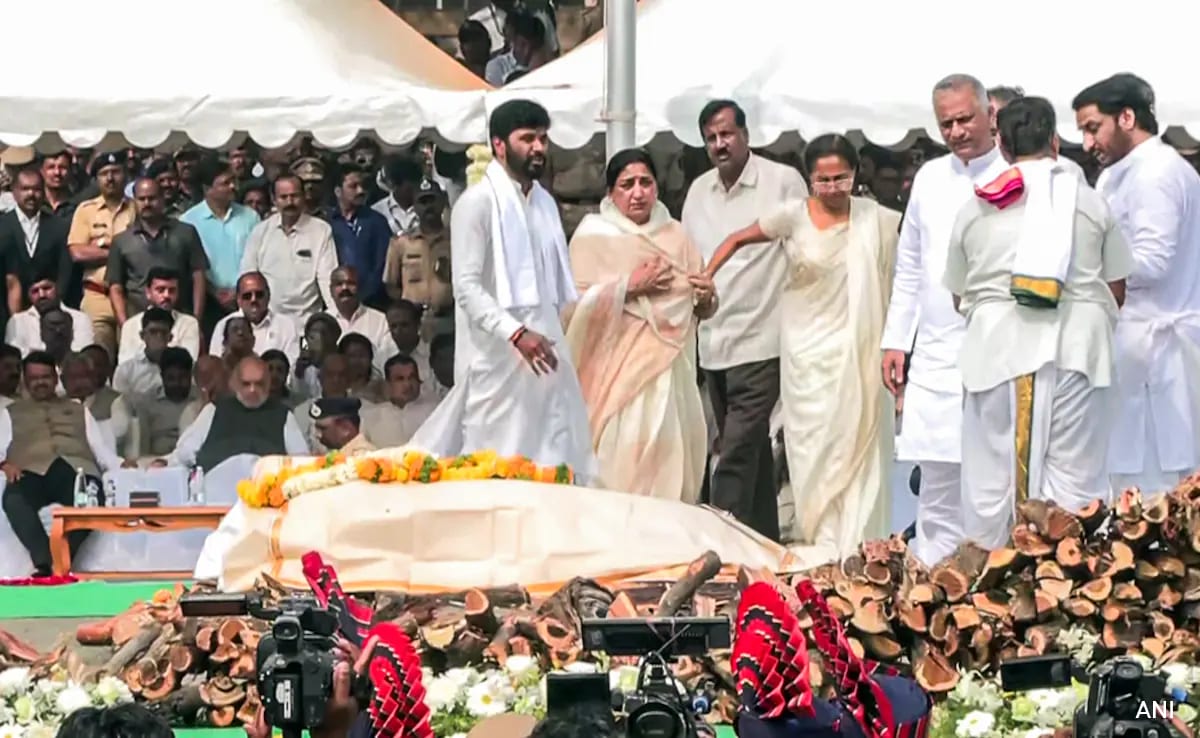
As the final rites commenced on Thursday, the fierce political rivalry that had seen the two women locked in a direct electoral contest just months prior seemed utterly distant and irrelevant. When religious 'vidhi' (rituals) were called out by the priests, Supriya Sule remained intimately close to Sunetra Pawar, literally guiding her through each step of the solemn ceremony. This act of unwavering companionship spoke volumes about the depth of their familial connection, overshadowing any past political battles and highlighting the human element behind public personas.
Perhaps one of the most heartbreaking yet profoundly beautiful moments occurred when Sunetra Pawar, her hands visibly trembling with grief, struggled to perform rituals involving the 'pooja thali'. Without hesitation, Supriya Sule stepped in, gently but firmly taking the heavy plate to hold it steady, allowing Sunetra Pawar to complete the sacred rites. It was a gesture of profound empathy and practical support that underscored the raw emotion of the moment, offering solace through shared burden.
Throughout the circumambulation rounds around the pyre, an integral part of the final rituals, Supriya Sule walked in lockstep with Sunetra Pawar, providing constant physical and emotional assistance. She carefully helped her navigate the steps, guiding her up and down with gentle reassurance, her hand never once leaving Sunetra Pawar’s. This continuous presence was a powerful symbol of solidarity, illustrating how personal tragedy can erase political lines, at least temporarily, revealing the deeper ties that bind.
It is particularly striking given the recent history. Less than a year ago, the headlines were dominated by the intense Lok Sabha electoral battle in Baramati, where Supriya Sule emerged victorious over Sunetra Pawar by a significant margin. This was followed by the Assembly elections, where the late Ajit Pawar himself had faced off against his nephew, Yugendra, further highlighting the deep political divisions within the family. Yet, in the face of such profound loss, the focus has shifted entirely from electoral contests to the enduring power of family, compassion, and human connection, offering a rare glimpse into the personal side of public figures and the complex tapestry of relationships in Indian politics.