Opinion: Opinion
By NewsDose Team
Updated on January 28, 2026
5 min read
Key takeaways
In the current world order, while hegemons can go it alone, everyone else is on the menu if they aren't at the table. That is the takeaway from Carney's speech, and that is what India needs to acknowledge as it tries to chart a course of its own.
In the evolving tapestry of global geopolitics, a stark message emerged from the recent World Economic Forum in Davos: the traditional world order, once a predictable framework for international relations, is no more. This profound shift, articulated with arresting clarity by Canadian statesman Mark Carney, serves as an urgent wake-up call for nations worldwide, particularly for a rising power like India navigating its own intricate path on the global stage.
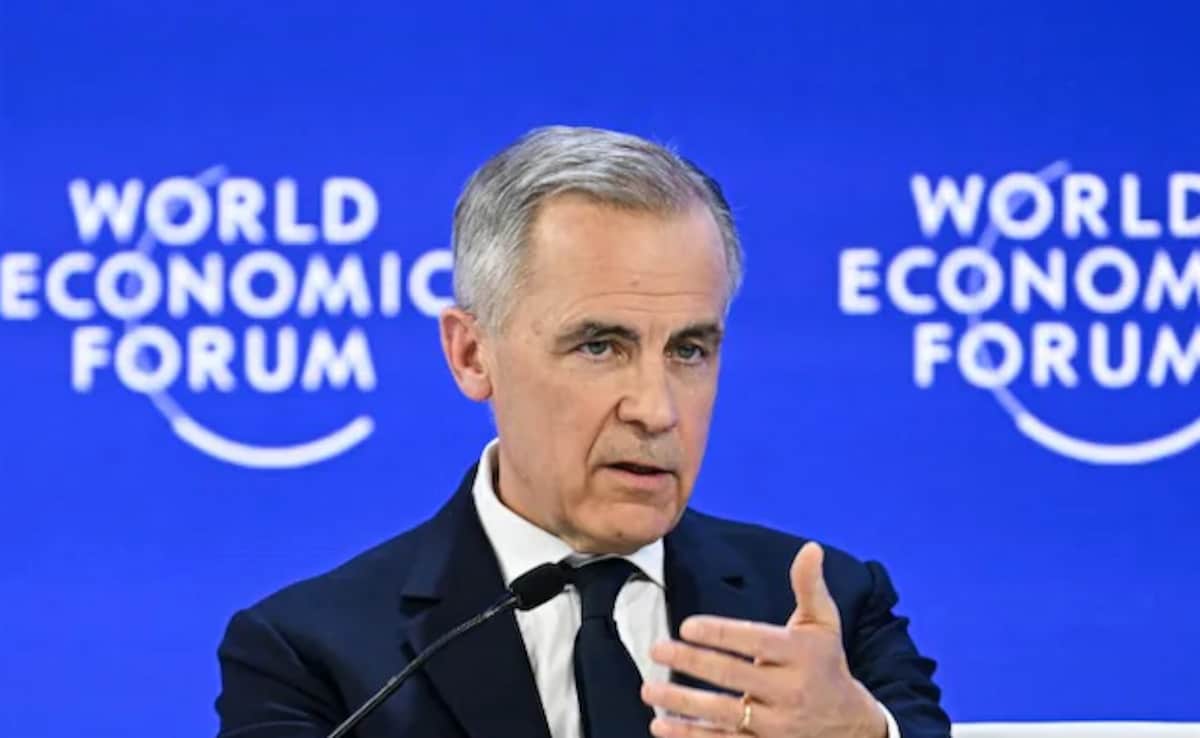
Carney, a figure who transitioned from the demanding corridors of central banking to the leadership of a G7 nation, delivered a speech that transcended diplomatic pleasantries. He spoke not of mere transition, but of a fundamental rupture in the global system, declaring the demise of the rules-based international order. His stark warning echoed the ancient Greek historian Thucydides: the grim reality where "the strong do what they can while the weak suffer what they must" is no longer a historical echo but our present lived experience. This candid assessment, met with a rare standing ovation, underscored a widespread unease among global leaders who might have privately held similar convictions but lacked the public courage to voice them.
For India, a nation poised at the cusp of significant global influence, Carney's analysis resonates with an unsettling familiarity. As 2026 unfolds, the intricate global architecture – once relied upon for trade, security, and the definition of national standing – faces systematic dismantling. The era of transactionalism in great power relations, increasingly evident in various spheres, necessitates an honest self-assessment, mirroring Carney’s unflinching realism.
A Strategic Compass for India
Carney's proposed strategy for Canada – fortifying domestic strength, diversifying international engagements, and forging issue-specific coalitions – offers a compelling lens through which India can examine its own strategic imperatives. These principles align remarkably with India’s long-standing emphasis on self-reliance and multi-alignment. However, for a continental-sized nation of 1.4 billion people, India’s approach demands a nuanced adaptation, balancing Carney’s middle-power solidarity with its unique aspirations for strategic autonomy.
A critical observation from Carney’s address was the futility of nostalgia. He urged nations to abandon the illusion of a return to the 1990s, highlighting the alarming reality that economic integration, once a driver of mutual benefit, is increasingly weaponised. From aggressive trade tariffs to the strategic manipulation of financial chokepoints, the global economy is evolving into an arena of coercion rather than cooperation.
India has, for some time, intuitively sensed this tectonic shift. Its proactive stance, evident in the decision to forego the Regional Comprehensive Economic Partnership (RCEP) and the ambitious Atmanirbhar Bharat (Self-Reliant India) mission, demonstrates a strategic foresight towards "de-risking" its economy long before the term became a global policy buzzword. This proactive stance must be buttressed by an unwavering commitment to clarity; clinging to the outdated notion that global institutions like the World Trade Organization (WTO) or the UN Security Council, in their current state of paralysis, will adequately safeguard national interests, is a perilous delusion. True resilience today is not about isolation but about a robust sovereignty anchored in the capacity to withstand external pressures.
Embracing the 'Middle' Power Paradigm with an Indian Twist
The most actionable facet of the so-called 'Carney Doctrine' is its advocacy for middle powers to coalesce. Carney compellingly argued that while hegemonic powers might navigate alone, all others risk becoming marginal if they lack a seat – or better yet, a strong collective voice – at the global decision-making table. India, despite its inherent aspirations as a leading power, stands to gain immensely from strategically embracing aspects of this middle-power collaboration.
Natural common causes exist with nations such as Canada, Japan, the United Kingdom, the ASEAN bloc, and the European Union. Consider the burgeoning opportunities: Canada's substantial investments in critical minerals and clean energy directly align with India's ambitious electric vehicle and green-tech agenda. By engaging in "buyers' clubs" with G7 nations and Canada, India can secure vital supply chains currently vulnerable to single-source monopolies. Similarly, in cutting-edge fields like Artificial Intelligence (AI) and quantum computing, India and Japan possess the potential to jointly spearhead the creation of open-source, democratic standards, thereby avoiding entrapment under a digital iron curtain that appears to be descending between major powers. Furthermore, akin to Canada's strategic integration into European defence procurement, India can deepen its Indo-European security ties with Germany and France, while prudently maintaining its established advantages with Russia, thereby hedging against the uncertainties of a potentially inward-looking United States. Such collaborations allow India to sidestep the perils of vassalage in an emergent bipolar world, embodying its identity as a "multi-aligned" power that builds a dynamic network rather than choosing static allegiances.
Crafting India's Own Table
However, while Carney speaks for a nation of 40 million, New Delhi represents the aspirations of 1.4 billion. India's sheer scale dictates that it cannot merely be a member of a middle-power bloc; it must serve as an anchor, a gravitational force. Consequently, there are significant areas where India must deviate from Carney's blueprint and forge its distinct path of strategic autonomy. Paramount among these is India's unequivocal leadership of the Global South, representing the collective voice of the silenced majority of humanity.
While Carney’s emphasis lies on values-based trade with Western partners, India's destiny is inextricably intertwined with the Global South. Its burgeoning influence in Africa and Southeast Asia extends beyond mere trade; it embodies the provision of an alternative development model – one that is neither Western-prescriptive nor Chinese-coercive. India must steadfastly maintain its unique role as a bridge between the established Davos elite and the dynamic, developing world.
Moreover, India must navigate the complex Russia-China paradox with a level of pragmatism that Western middle powers typically do not require. For many Western nations, Russia represents a clear adversary. For India, however, the relationship is profoundly nuanced by decades of defence cooperation, enduring diplomatic support, and an undeniable pragmatic need for energy security. Its multi-alignment strategy – balancing engagement with forums like the Quad with continued involvement in BRICS – is not merely a preference but a geopolitical necessity. Unlike Canada, which recently inked a significant agreement with China in Beijing, India contends with a long and periodically contested frontier with China, where territorial probes remain a constant concern. Canada does not face the reality of foreign troops encroaching upon its sovereign territory.
Crucially, India must continue to resist external pressures to align definitively in conflicts that do not serve its immediate national interest. This external autonomy must be fortified by robust domestic foundations. While Carney spoke of enhancing domestic strength through tax reform and inter-provincial trade, India's undertaking is Herculean. Its internal fortress must be built upon the rapid formalisation of its vast economy, the massive upskilling of its youthful demographic, and the accelerated creation of a cutting-edge technological infrastructure and a globally competitive manufacturing base capable of offering a viable alternative to existing global supply chains. Ultimately, India's strategic autonomy is directly proportional to the strength and resilience of its GDP growth.
Redefining Power in a Fragmented World
The world Carney describes is one of variable geometry – a messy, fragmented, yet intensely dynamic international system. We are inexorably moving towards a multinodal world where influence is acquired less through a symbolic seat at an increasingly questioned UN Security Council, and more through the leverage derived from the sheer relevance of one's domestic market and the attractiveness and reliability of one's exports. To effectively navigate this landscape, India must embody a strategic blend of principled conviction and pragmatic adaptability. Multi-alignment and strategic autonomy are not merely rhetorical flourishes; they must be meticulously honed instruments for acquiring and deploying the leverage that India is still actively developing and has yet to fully consolidate.
India should unequivocally commend Carney for his courage in dissecting the hypocrisies of the old order and actively join in the construction of new, resilient trade corridors. However, it must also remain acutely aware that in the "world of fortresses" that the Canadian statesman decried, India is a continent-sized entity. Its most potent defence is not merely securing a seat at an existing table, but rather the profound realisation that it possesses the capacity and the mandate to construct its own table, one at which other nations will genuinely desire to be served.
Carney encapsulated his vision by stating a desire to shift from reliance on "the strength of our values" to "the value of our strength." In this critical domain, India possesses an immense reservoir of strength yet to be fully invested and leveraged. This includes its imminent ascent to become the world's third-largest economy, its increasingly acknowledged status as a first-tier AI power, and the profound value embodied in its pluralism, diversity, and the compelling allure of its soft power. From the majestic Himalayas to the strategic expanse of the Indian Ocean, it is India’s paramount duty to ensure that while the old rules of the global order may be fading into history, the new ones will emphatically not be written without its decisive influence.