Opinion: Opinion
By NewsDose Team
Updated on January 28, 2026
5 min read
Key takeaways
Trump's Board of Peace project is an attempt to return the world to a pre-war model, in which leaders of the great powers would convene forums to redraw maps and sign treaties.
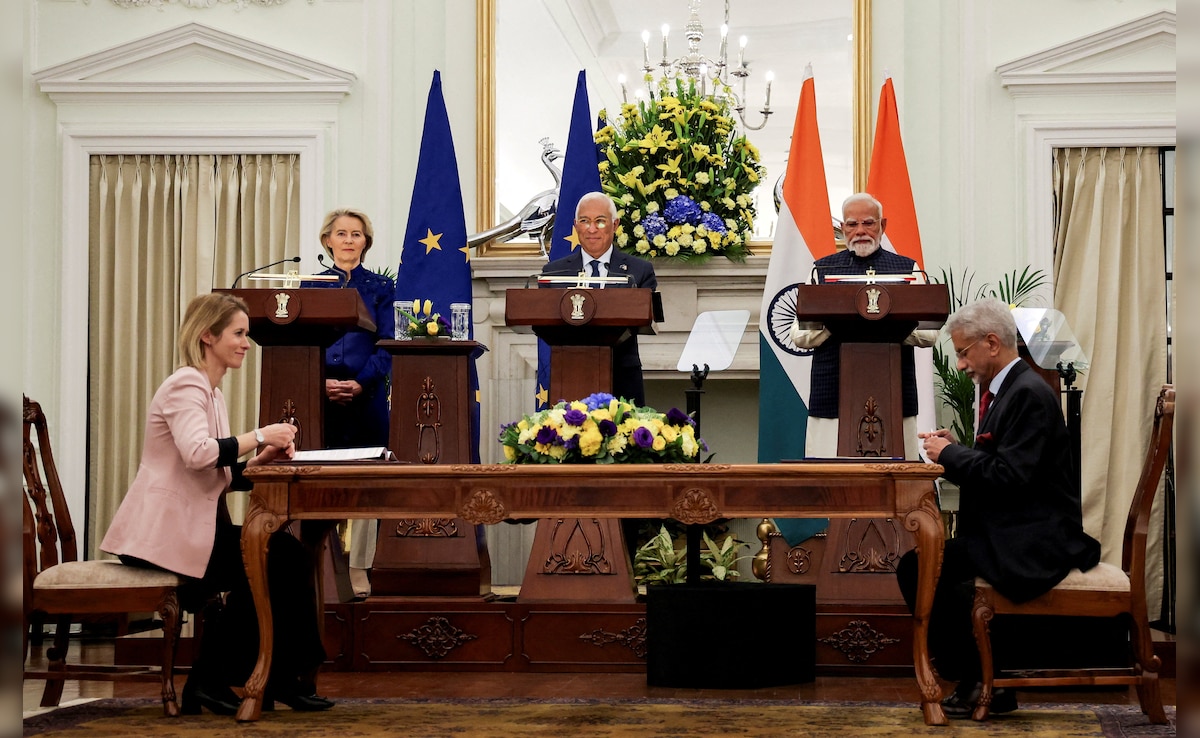
The recent signing of the India-European Union Free Trade Agreement (FTA) on January 27, 2026, marks a pivotal moment in global trade, emerging after nearly two decades of often-stalled negotiations. Its true significance transcends mere tariff adjustments, offering a profound lesson from history: the intricate structure of trade incentives often dictates outcomes more than the face value of prices. This echoes the European railways' experience in the 1960s, where dismantling internal freight tariffs failed to enhance efficiency; instead, political considerations rerouted cargo, leading to lengthened delivery times and increased costs. The failure wasn't in insufficient tariff cuts, but in altering relative incentives without addressing underlying structural issues.
A Geopolitical Catalyst: US Trade Coercion Forges New Alliances
This landmark agreement must be understood through the lens of recent geopolitical shifts. Far from being a simple bilateral trade pact, it represents a strategic alignment between two seemingly reluctant partners, catalyzed by aggressive US trade policies. The era of elevated tariffs under previous US administrations, coupled with persistent critical rhetoric, inadvertently turbo-charged a quiet but significant re-wiring of India-EU economic ties. This phenomenon underscores what can be termed a 'spite multiplier' in trade diplomacy, where external pressure, intended to assert dominance, instead pushes nations towards unexpected cooperation.
The impact of this unintended consequence is particularly evident in the sentiments of those who championed the coercive US trade approach. Reports suggest a palpable sense of 'fear of missing out' (FOMO) among former US trade advisors, indicative of disbelief and regret, as they witness the unfolding of what some are calling the 'mother of all deals' – an agreement forged without Washington's direct involvement. This reactive shift highlights the complexities and unforeseen ripple effects of protectionist measures on the global economic landscape.
Beyond Tariffs: Unpacking the Asymmetric Nature of Liberalisation
On conventional metrics, the India-EU FTA might not appear overwhelmingly groundbreaking at first glance. Before the agreement, the EU's average applied tariff on Indian goods was modest, typically ranging between 3-4%, with over 75% of Indian exports already facing tariffs below 1%. In contrast, India's applied tariffs on EU goods were significantly higher, averaging 10-12%, with steep peaks reaching 110% on automobiles, 150% on wines and spirits, and over 40% on machinery. This makes the liberalisation appear asymmetric, with India seemingly conceding more on paper than it immediately gains in direct tariff reductions.
However, evaluating trade agreements solely on tariff lines provides an incomplete picture. As Jacob Viner's theory of customs unions suggests, the welfare impact of preferential trade hinges on whether it generates 'trade creation' – shifting production to more efficient producers – or 'trade diversion' – shifting trade from more efficient non-member producers to less efficient member producers. India's pre-2020 trade architecture exemplified the latter. Preferential agreements with ASEAN, Japan, and Korea eliminated tariffs on a vast percentage of tariff lines, often exceeding WTO requirements. Yet, persistent non-tariff barriers in partner markets specifically constrained sectors where India held a competitive edge. This led to situations like India's trade deficit with ASEAN widening dramatically, illustrating a scenario where market access existed formally but lacked functional efficacy.
Global Value Chains in Flux: The Impact of US Protectionism
This unsustainable model became untenable amidst the destabilisation of global value chains between 2018 and 2024. During this period, US tariff coverage expanded significantly, impacting over $500 billion of global trade annually. India, for instance, faced direct duties of up to 50% on exports to the US across key sectors such as auto components, gems and jewellery, marine products, and electrical machinery. Similarly, the EU contended with 25% tariffs on steel and aluminium, threats of additional levies related to technology regulation, and explicit geopolitical pressure concerning Greenland and defence policy. This era underscored a critical shift: access to the US market was no longer consistently rule-based but increasingly contingent on geopolitical considerations.
The economic response to such widespread protectionism was predictable: firms began reallocating trade flows away from tariff-exposed routes. This trend became strikingly apparent in Indian export data from late 2025. For instance, gems and jewellery exports to the US plummeted by over 75% year-on-year in September. Yet, total exports saw only a marginal decline of 1.5%, largely cushioned by a nearly 80% surge in shipments to the UAE and an 8% increase to Belgium. Similarly, auto component exports to the US fell by 12%, but robust demand from Germany and other European markets ensured total exports grew by 8%. Marine product exports also registered over 20% growth, predominantly driven by surging EU demand.
The 'Mother of All Deals' Institutionalises Re-Routing
The India-EU FTA effectively institutionalises this strategic re-routing of global trade. Encompassing economies that collectively represent approximately 25% of global GDP, 30% of the world's population, and over $11 trillion in global trade, the agreement is monumental. It eliminates or significantly reduces tariffs on an impressive 96.6% of EU exports to India and grants preferential access to over 99% of Indian exports by value. For the EU, annual tariff savings are estimated at EUR 4 billion, with goods exports projected to double by the early 2030s. For India, the primary value proposition lies not just in tariff reduction but crucially in gaining regulatory certainty and predictable market access across a vast customs union of 27 nations.
The agreement's considerable technical depth reflects this underlying logic. Beyond goods, it mandates services liberalisation across 144 EU subsectors and 102 Indian subsectors, surpassing commitments India has made in previous agreements with partners like the UK or Australia. It integrates robust mobility frameworks for intra-corporate transferees, contractual service suppliers, and independent professionals. Furthermore, the inclusion of rapid-response mechanisms designed to escalate non-tariff disputes is a tacit acknowledgement that contemporary trade often faces binding constraints not from tariffs, but from complex standards, quality controls, and procurement rules. This proactive approach aims to streamline and future-proof trade relations.
Most notably, the agreement proactively addresses future regulatory shocks, such as the EU's impending Carbon Border Adjustment Mechanism (CBAM), which threatens to impose double-digit effective tariffs on carbon-intensive Indian exports. Rather than challenging the principle of CBAM, India shrewdly negotiated Most Favoured Nation (MFN)-style assurances, verifier recognition, and technical and financial support. This strategic provision may serve as a crucial insurance policy against the potential weaponisation of regulatory measures in the future, safeguarding Indian industries from unexpected trade barriers.
A Hedge Against Coercion: Forging Economic Security
Both India and Europe frame this agreement as an essential economic security partnership. For Europe, it represents a crucial step towards reducing its dependence on China for critical technologies and raw materials, fostering greater supply chain resilience. For India, the agreement ensures predictable access to advanced, developed markets at a time when the US has demonstrated an increasing willingness to use trade as a tool of geopolitical coercion. The public criticism of the deal by a US Treasury secretary, who argued that Europe was 'financing war against itself' by trading with India, only serves to underscore the agreement's role as a potent hedge against such coercion, rather than an endorsement of any singular geopolitical alignment.
While critics outside India may argue that the deal remains incomplete – noting, for instance, the exclusion of agriculture or European industry's wariness of Indian standards regimes, and Indian exporters' vulnerability to EU regulatory density – these are valid points. However, incompleteness does not diminish strategic value. The breakdown of the 2013 negotiations stemmed from a lack of leader-level ownership and a narrow focus on immediate trade gains. The 2026 agreement succeeds precisely because it internalises pervasive uncertainty and embeds mechanisms for adaptation, building a framework that can evolve with future challenges.
In this broader context, the India-EU FTA is less about traditional liberalisation and more about building resilience within the global trading system. US tariffs did not make India and Europe more competitive; rather, they made dependence on specific trade routes more expensive and distorted existing incentives. This, in turn, forced a strategic re-routing of trade flows. The agreement now formalises this re-routing into a durable, institutionalised architecture.
History consistently shows that trade systems evolve not smoothly, but through shocks that expose hidden fragilities and prompt strategic recalibrations. If this pattern holds true, then the paradox will endure: America's determined attempt to reassert control over global trade flows may, ironically, be remembered as the decisive moment when two major, cautious economies chose to collectively design alternative routes that effectively bypassed it, ushering in a new era of diversified global economic partnerships.