"Problems Won't Solve By One Power Calling Shots": UN Chief's Dig At Trump
By NewsDose Team
Updated on January 30, 2026
5 min read
Key takeaways
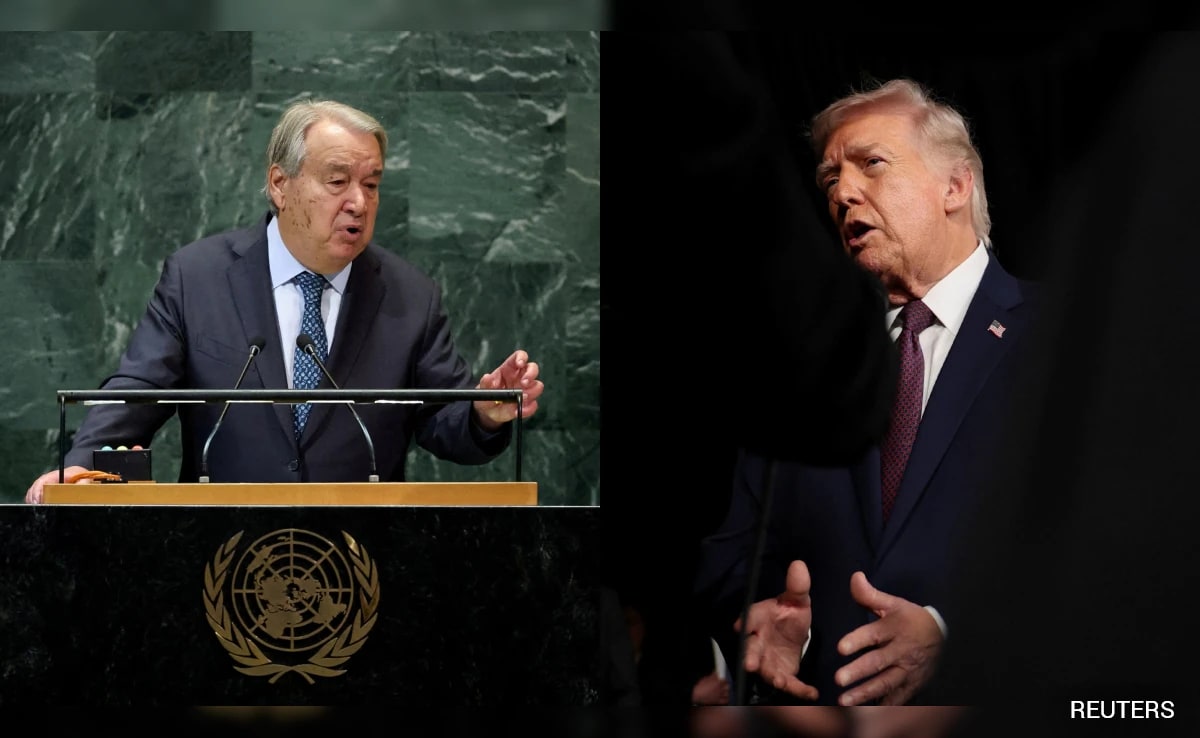
Global problems will not be solved by one power "calling the shots" or by splitting the world into rival spheres, United Nations Secretary-General Antonio Guterres said on Thursday in comments directed at the United States and China.
United Nations Secretary-General Antonio Guterres has issued a stern warning against the escalating global power rivalry between the United States and China, asserting that such a division poses a significant threat to international peace and sustainable development. Speaking to reporters as he commenced his tenth and final year in office, Guterres emphatically stressed the critical need for a multipolar world order to address the myriad complex challenges facing humanity.
During his address, Guterres made it unequivocally clear that global problems cannot be resolved by a single dominant power "calling the shots" or by carving the world into antagonistic spheres of influence. While initially speaking broadly, he later specified that his comments were primarily directed at the United States and, by extension, the emerging two-pole vision of a world centered around Washington and Beijing.
“If we desire a stable world, one where peace can be genuinely sustained, where development can be universally generalized, and ultimately, where our shared values will prevail, then we absolutely must champion multipolarity,” Guterres articulated. This vision stands in stark contrast to any scenario where two dominant powers dictate the terms of global engagement, potentially leading to increased tension and instability, and undermining the collective security framework.
The Secretary-General’s remarks resonate particularly strongly given the current geopolitical landscape. US President Donald Trump, now in his second term, has actively pursued policies that many in the international community perceive as resurrecting an outdated worldview centered on great power spheres of influence. His commitment to restoring US dominance, particularly in the Western Hemisphere, highlights the very trend Guterres is cautioning against, suggesting a return to Cold War-era dynamics rather than fostering collaborative solutions.
Just a week prior to Guterres’s statements, President Trump had unveiled his "Board of Peace," an initiative initially conceived to solidify a precarious ceasefire in Gaza. However, the President has expressed ambitions for this initiative to take on a broader, more expansive role in global conflict resolution – an approach that has reportedly caused apprehension among several international powers. Guterres, in turn, underscored the UN’s fundamental mandate in this regard, reminding the global community of the established mechanisms for international peace.
“In my considered opinion, the primary responsibility for maintaining international peace and security rests squarely with the United Nations, and specifically with the Security Council,” Guterres affirmed. He passionately argued that this inherent responsibility makes the reform of the Security Council not just desirable, but absolutely essential for the global body’s efficacy in the 21st century. He also pointed out a significant irony: “It is remarkably interesting to observe that some of those who are quickest to criticize the UN for its perceived ineffectiveness are precisely the ones opposing the vital reforms of the Security Council. This opposition, in essence, is why the UN sometimes cannot achieve the level of effectiveness we all aspire to.” This resistance, he implied, directly hinders the UN’s capacity to respond to modern challenges.
Guterres's second five-year tenure has indeed been characterized by an alarming succession of global crises. These include the full-scale invasion of Ukraine by Russia, the complex return of the Taliban in Afghanistan, the devastating conflict in Sudan, the protracted war between Israel and Palestinian militants Hamas in the Gaza Strip, the surprisingly swift end to Syria's civil war, and the recent US capture of Venezuela's President Nicolas Maduro. These tumultuous events, he observed, paint a grim picture of multilateralism under assault and a weakening adherence to international norms.
“International law is being blatantly trampled upon. The spirit of cooperation is visibly eroding. And our crucial multilateral institutions are facing unprecedented attacks on numerous fronts,” Guterres lamented. He further warned that "impunity is currently driving today's conflicts—fuelling escalation, widening mistrust, and literally kicking the doors open for powerful spoilers to enter from every conceivable direction," a stark assessment of the current global disorder that threatens to unravel decades of diplomatic progress.
Compounding these geopolitical challenges, the United Nations is also grappling with a severe financial crisis. The world body's largest contributor, the United States, has notably curtailed voluntary funding to numerous UN agencies and has also reportedly withheld mandatory payments to both the UN’s regular and peacekeeping budgets. In response to these fiscal pressures and the broader need for modernization, Guterres launched the UN80 reform task force in March, a pivotal initiative aimed at enhancing efficiency and reducing operational costs across the organization, ensuring its continued relevance and capacity.
This financial strain and the Secretary-General’s calls for reform are set against a backdrop of differing views on the UN's role. President Trump, while acknowledging the UN's "great potential," has frequently criticized its perceived failures, particularly its alleged lack of support for American-led peace endeavors. He has controversially suggested that he deserves the Nobel Peace Prize for his interventions in various conflicts, despite many of these issues remaining unresolved and fresh conflicts flaring in some regions, raising questions about the efficacy and long-term impact of such unilateral approaches.
Despite this formidable array of hurdles and the external criticisms, Secretary-General Guterres remains resolute in his commitment to the UN's founding principles. “Despite all the obstacles, the United Nations continues to act decisively to imbue our shared values with tangible life,” he declared with conviction. “And we will not surrender. We are relentlessly pushing for peace – a peace that is just, a peace that is sustainable, and a peace that is deeply rooted in international law. A peace that comprehensively addresses the underlying root causes of conflict. A peace that endures long beyond the mere signing of an agreement.” His words serve as a powerful testament to the enduring mission of the United Nations in a fragmented and increasingly complex world, emphasizing the necessity of collective action for lasting global stability.
You Might Also Like


More in World
- "Iran's Pilot Exodus: War Pushes Talent To India"
- ‘Terror plot’: Who is Matthew VanDyke, the US citizen arrested by India’s NIA?
- Is America already trapped in an unwinnable war with Iran?
- "US Missile Stockpile Drained? Trump's Iran War Costs $5Bn in 2 Days"
- Solar Eclipse 2026: Here's what every student should know about the year’s first ‘Surya Grahan’
