Solar Eclipse 2026: Here's what every student should know about the year’s first ‘Surya Grahan’
By NewsDose Team
Updated on February 18, 2026
5 min read
Key takeaways
Learning with TOI News: Surya Grahan 2026: When students hear that a solar eclipse is approaching, the first question is, will it be visible from India?Today, February 17, 20.
The arrival of a solar eclipse always sparks immense public curiosity and scientific fascination worldwide. On February 17, 2026, the celestial stage was set for the year's inaugural solar eclipse, an annular event that captured the attention of astronomers and space enthusiasts globally. While the dramatic 'Ring of Fire' spectacle captivated observers across specific regions of the Southern Hemisphere, a significant portion of the world, including India, experienced an ordinary day, prompting questions about the mechanics and global visibility of such astronomical wonders.
For many, the initial query whenever a solar eclipse is announced revolves around local visibility. Unfortunately, for residents across India, this particular astronomical alignment was not directly observable. However, the event transcended geographical boundaries as a profound educational opportunity, serving as a powerful catalyst for understanding the intricate dance of celestial bodies and the fundamental principles governing our solar system. Even without direct sight, the scientific insights derived from such events are universally accessible and invaluable.
Understanding the Mechanics of a Solar Eclipse
A solar eclipse is a breathtaking cosmic alignment that occurs when the Moon positions itself directly between the Earth and the Sun during its New Moon phase. This precise configuration causes the Moon to obstruct a portion, or sometimes all, of the Sun's light from reaching specific parts of our planet. The rarity of this phenomenon, occurring not every month despite the Moon's regular orbit, is attributed to the slight tilt of the Moon's orbital path relative to Earth's orbit around the Sun. Only when these three celestial bodies align sufficiently close and in the correct plane does an eclipse manifest.
From an astronomical perspective, a solar eclipse is a magnificent display of cosmic geometry and gravitational interaction. It represents a shadow event, a temporary obscuration of light, rather than any intrinsic change in the Sun itself. While various cultural traditions interpret these 'Surya Grahan' events through diverse lenses, often associating them with new beginnings or transitions in astrological contexts, the scientific community views them as predictable and measurable outcomes of the consistent orbital motions of planetary bodies.
The Unique Spectacle of an Annular Solar Eclipse: The 'Ring of Fire'
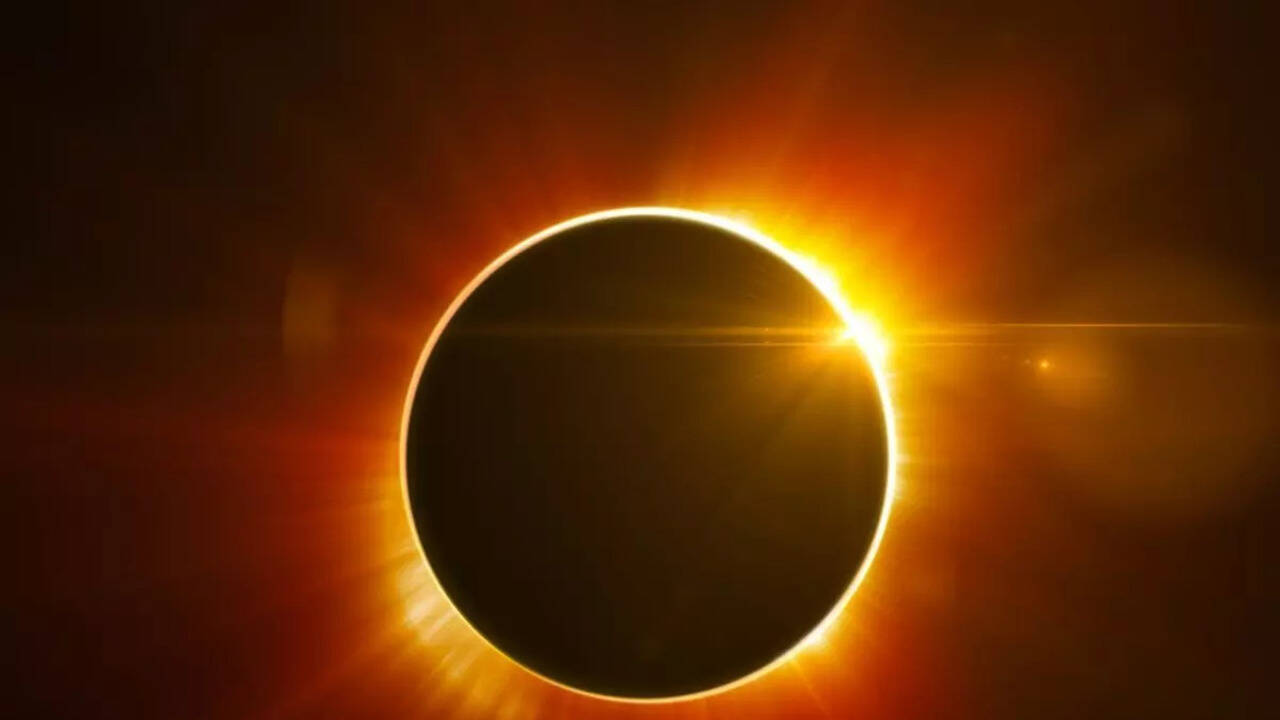
Not all solar eclipses present the same visual drama. The event on February 17, 2026, was specifically an annular solar eclipse, a distinct type characterized by a captivating 'Ring of Fire'. This particular phenomenon unfolds when the Moon, in its elliptical orbit, is at a point farther away from Earth. Consequently, its apparent size in the sky is slightly smaller than usual.
When this smaller-appearing Moon passes directly in front of the Sun, it does not completely obscure our star. Instead, while the central portion of the Sun is blocked, its outer edges remain brilliantly visible. This creates a mesmerizing, luminous ring of sunlight encircling the dark silhouette of the Moon – a visual spectacle famously known as the 'Ring of Fire'. The scientific explanation behind this awe-inspiring visual is not dramatic but purely mathematical: it's a consequence of the subtle variations in the apparent sizes of the Sun and Moon, which fluctuate based on their respective distances from Earth and from each other. When the Moon's apparent diameter is smaller than the Sun's, the result is an annular rather than a total eclipse.
Global Reach and Observational Zones
The first solar eclipse of 2026, while not visible in India, traversed a significant path across the globe. Enthusiastic sky-watchers in various parts of southern Africa, including nations such as South Africa, Namibia, Botswana, Zimbabwe, and Tanzania, were treated to the incredible sight. The 'Ring of Fire' was also visible from the picturesque island nation of Mauritius, extending its path across parts of Argentina, the icy expanses of Antarctica, and other regions of southern South America. For students and the public in India who were unable to witness it directly, prominent space agencies and scientific organizations, such as the National Aeronautics and Space Administration, provided extensive live updates and scientific coverage, enabling a virtual experience of this grand celestial ballet.
Why Eclipses Are Highly Localized Events
The localized nature of a solar eclipse's visibility often prompts questions. The reason is straightforward: the Moon’s shadow, which creates the eclipse, falls upon a relatively limited area of Earth’s surface. Our planet is vast, and the Moon’s shadow cone is comparatively narrow. As the Earth rotates and the Moon continues its orbital journey, this shadow traces a specific, often narrow, path across continents and oceans. Regions located outside this particular path simply do not experience the eclipse, maintaining an ordinary daytime sky. This explains why observers in one part of the world might witness the spectacular 'Ring of Fire,' while those in another region experience no noticeable change in daylight.
An Invaluable Learning Opportunity for Aspiring Scientists
The February 17, 2026, annular solar eclipse serves as a powerful reminder that the universe operates on principles of motion, distance, and precise alignment. An eclipse is not a mystical event but a predictable consequence of the Earth, Moon, and Sun moving along their established orbital paths. Even if direct observation was not possible from every corner of the globe, particularly in India, the event remains an incredibly valuable educational moment.
It encourages students to delve into concepts such as the New Moon phase, the intricacies of orbital motion, the reasons behind the Moon’s varying apparent size, and the fundamental mechanics of shadows in the vastness of space. Celestial events transcend borders and visibility; they occur according to universal physical laws, offering boundless opportunities for learning and discovery. While the first solar eclipse of 2026 may have cast its shadow and light across specific parts of Africa and South America, leaving Indian skies unchanged, the knowledge and scientific understanding it imparts are universally accessible, fostering a deeper appreciation for the cosmos in all curious minds.
You Might Also Like


More in World
- "Iran's Pilot Exodus: War Pushes Talent To India"
- ‘Terror plot’: Who is Matthew VanDyke, the US citizen arrested by India’s NIA?
- Is America already trapped in an unwinnable war with Iran?
- "US Missile Stockpile Drained? Trump's Iran War Costs $5Bn in 2 Days"
- How Louvre Museum In Paris Lost Over Rs 100 Crore In Ticket Scam
