James Webb Space Telescope Spots Most Distant Galaxy That Existed 280 Million Years After Big Bang
By NewsDose Team
Updated on January 30, 2026
5 min read
Key takeaways
MoM-z14's light has travelled over 13.5 billion years to reach Earth, the scientists have revealed.
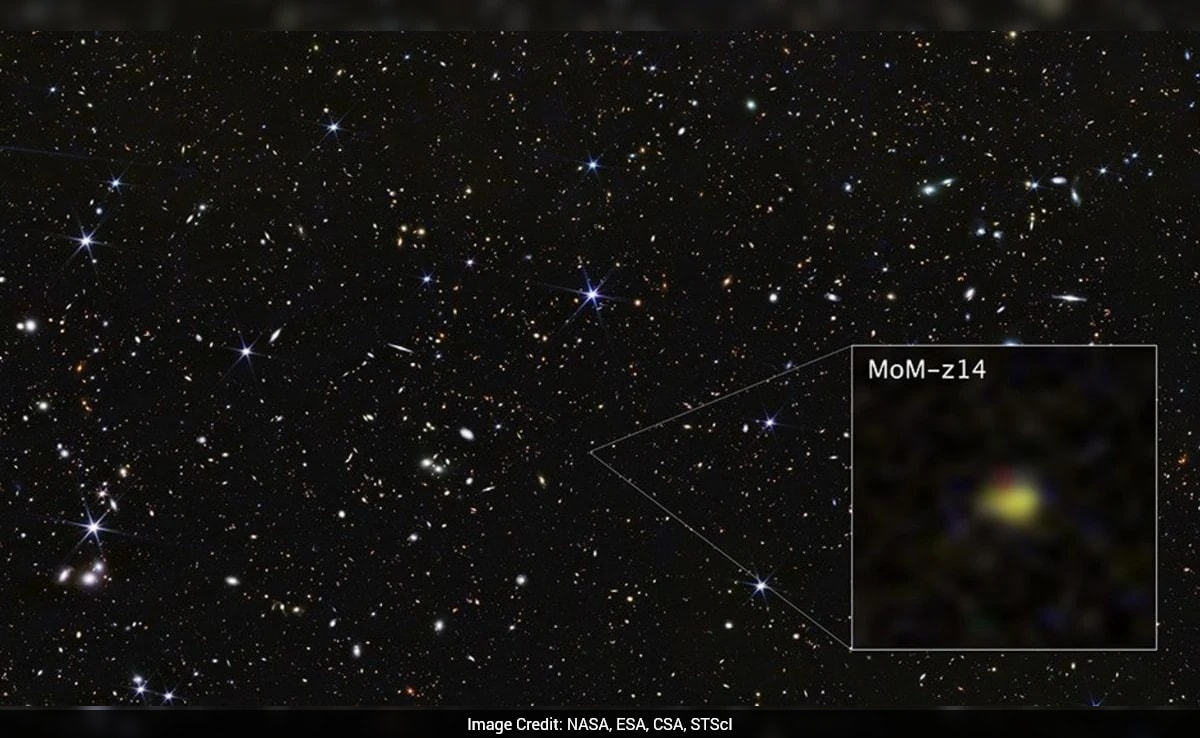
The cosmos has once again yielded a breathtaking secret, thanks to the unparalleled observational prowess of the James Webb Space Telescope (JWST). Astronomers across the globe are buzzing with excitement following the discovery of the most distant galaxy ever observed, an astounding celestial body designated MoM-z14.
This remarkable galaxy existed in the universe’s nascent stages, a mere 280 million years after the Big Bang – a blink of an eye in cosmic terms. What truly sets MoM-z14 apart, however, is not just its extreme distance but its unexpected characteristics. Initial analyses reveal that this ancient galaxy is significantly brighter, denser, and chemically richer than prevailing theoretical models of the early universe had predicted. This discovery provides crucial new insights into how galaxies formed and evolved during the universe's cosmic infancy.
Researchers involved in the groundbreaking study have expressed both astonishment and exhilaration. As one lead scientist highlighted, the capabilities of this advanced observatory allow humanity to peer further into the past than ever before, revealing a cosmic landscape that defies prior expectations, presenting both profound challenges and thrilling avenues for future exploration. The findings from MoM-z14 have been meticulously detailed in a recent scientific paper, contributing significantly to our understanding of nascent galactic structures.
Confirming the precise distance and nature of such ancient objects is paramount. Another co-investigator emphasized the critical importance of spectroscopic follow-up to initial imaging, ensuring accuracy in pinpointing exactly what astronomers are observing and at what epoch in the universe's history.
The light from MoM-z14 embarked on an epic journey across the vast expanse of space, traveling for over 13.5 billion years to finally reach our planet. This incredible temporal voyage means we are witnessing the galaxy as it was in its formative years. The implications of this observation are profound, exposing what scientists are referring to as a "growing chasm" between established theoretical frameworks and the tangible evidence now being gathered from the early universe. This disparity compels the scientific community to re-evaluate and refine our current cosmological paradigms.
A particularly intriguing aspect of MoM-z14 is its unusual chemical composition, which includes notably high amounts of nitrogen. This chemical signature serves as a compelling indicator of exceptionally rapid and vigorous star formation occurring in the earliest epochs of the cosmos. Such intense stellar nurseries, creating stars at a much faster rate than anticipated, contribute directly to the galaxy's unexpected brightness and density.
The James Webb Space Telescope continues to revolutionize astrophysics with each new observation. Its capacity to detect fainter, more distant galaxies than previously thought possible is systematically rewriting our understanding of the universe's dawn. These revelations are not merely filling gaps in our knowledge; they are challenging foundational theories and opening entirely new chapters in the story of cosmic evolution. As another member of the research team eloquently put it, while we can study ancient stars within our own galaxy as "fossils" from the early universe, the observatory offers a unique privilege: direct observation of galaxies from that very distant era, revealing shared and surprising features like this enigmatic nitrogen enrichment.
This monumental discovery underscores the dynamic and unpredictable nature of the universe. It serves as a powerful reminder that our journey to comprehend our cosmic origins is far from over, and with tools like the James Webb Space Telescope, we are continually pushed to expand the boundaries of human knowledge.
You Might Also Like


More in World
- "Iran's Pilot Exodus: War Pushes Talent To India"
- ‘Terror plot’: Who is Matthew VanDyke, the US citizen arrested by India’s NIA?
- Is America already trapped in an unwinnable war with Iran?
- "US Missile Stockpile Drained? Trump's Iran War Costs $5Bn in 2 Days"
- Solar Eclipse 2026: Here's what every student should know about the year’s first ‘Surya Grahan’
