Opinion: Opinion
By NewsDose Team
Updated on January 28, 2026
5 min read
Key takeaways
Trump's Board of Peace project is an attempt to return the world to a pre-war model, in which leaders of the great powers would convene forums to redraw maps and sign treaties.
Decades ago, in the 1960s, when European railway systems moved to dismantle internal freight tariffs, the anticipated boost in efficiency did not materialize despite a reduction in prices. This historical episode offers a profound insight into the complexities of trade policy, revealing that simply adjusting tariffs does not guarantee improved outcomes. Instead, the restructuring led to cargo being rerouted along paths dictated more by political expediency than economic rationale. This resulted in elongated delivery schedules and an unwelcome surge in operational costs. The fundamental flaw in that liberalisation effort was not an insufficient reduction in tariffs, but rather a miscalibration of relative incentives within the new framework. This seminal event underscores a critical lesson in trade policy: the underlying structural architecture and incentive mechanisms often hold more sway over actual outcomes than mere price adjustments.
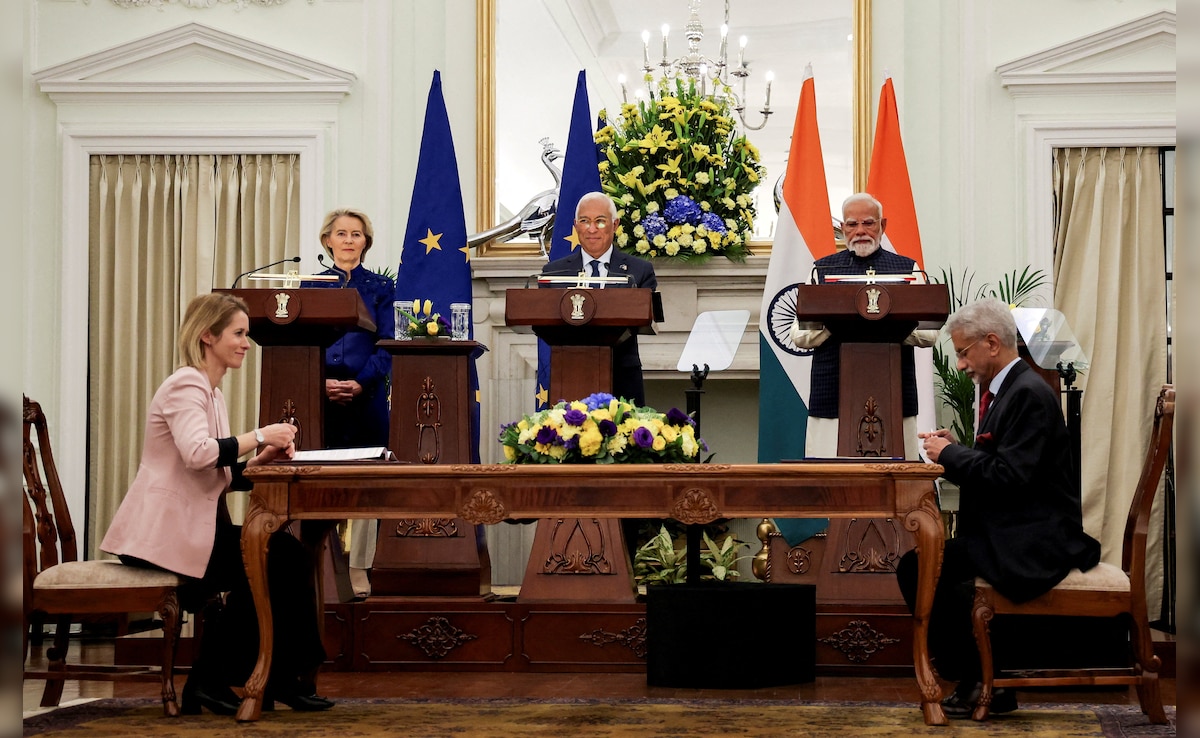
It is through this lens that we must interpret the significance of the India-European Union free trade agreement, formally signed on January 27, 2026. This landmark accord comes after nearly two decades of often-stalled, complex negotiations. Its true importance extends far beyond the conventional arithmetic of tariff reductions. Rather, its gravitas lies in how external trade coercion, particularly from the United States, so severely distorted existing incentives that it inadvertently pushed two previously reluctant partners into a powerful, strategic alignment. In this context, American tariffs have undeniably served as an unexpected catalyst, reshaping global economic pathways.
When Pressure Backfires Spectaculalry
The protectionist tariffs introduced by the previous U.S. administration, coupled with a steady stream of critical commentary from key economic advisors and financial figures such as Navarro, Bessent, and Lutnick, aimed at India, have produced a spectacularly unintended consequence. Far from isolating, these actions have inadvertently turbocharged a quiet yet profound re-wiring of economic ties between India and the European Union. Trade diplomacy, it turns out, possesses a significant 'spite multiplier'. It's hardly surprising that recent public appearances by commentators like Scott Bessent have conveyed an unmistakable air of 'FOMO' – a sentiment oscillating between disbelief and regret – particularly after news emerged of this so-called 'mother of all deals' being meticulously stitched together without Washington's direct involvement.
On conventional, quantitative metrics, the immediate impact of this agreement might not appear overwhelmingly transformative. Prior to this new framework, the EU’s average applied tariff on Indian goods stood at a modest 3-4%. A substantial portion, over 75% of Indian exports to the EU, already faced tariffs below 1%. Conversely, India’s applied tariffs on EU goods averaged a higher 10-12%, with significant peaks reaching 110% on luxury automobiles, 150% on wines and spirits, and over 40% on various types of machinery. Consequently, the liberalisation outlined in the agreement is, on paper, notably asymmetric, with India seemingly conceding more in terms of tariff reductions than it directly receives.
A Rapidly Changing Global Order
However, the assessment of complex trade agreements cannot be confined solely to an analysis of tariff lines. As eloquently argued by Jacob Viner in his foundational theory of customs unions, the welfare impact of preferential trade hinges critically on whether such agreements primarily generate 'trade creation' or 'trade diversion'. India’s pre-2020 trade architecture regrettably presented a textbook case of the latter. Preferential agreements with key partners such as ASEAN, Japan, and Korea saw the elimination of tariffs on a vast number of tariff lines, often exceeding 74-85% and far surpassing World Trade Organization requirements. Yet, crucially, non-tariff barriers in these partner markets disproportionately constrained precisely those sectors where India held a competitive edge. This imbalance was starkly evident as India’s trade deficit with ASEAN widened dramatically, escalating from approximately $5 billion at the agreement’s entry into force to over $21 billion by fiscal year 2019. Market access, while formally existing, remained functionally elusive.
This established model became increasingly untenable and unsustainable once global value chains began to experience unprecedented destabilisation. Between 2018 and 2024, the scope of U.S. tariffs expanded dramatically, coming to affect an astonishing annual sum of over $500 billion in global trade. India itself faced direct duties of up to 50% on specific exports to the U.S. market, encompassing critical sectors such as auto components, gems and jewellery, marine products, and electrical machinery. The European Union was not spared either, contending with steel and aluminium tariffs of 25%, alongside credible threats of additional levies linked to technology regulation and explicit geopolitical pressure concerning issues like Greenland and defence policy. Even nations that had previously secured signed trade frameworks discovered that access to the vital U.S. market was no longer consistently rule-based but had become increasingly contingent and subject to political whims.
The resultant economic response from affected firms was entirely predictable. Companies rapidly reallocated their trade flows, diverting them away from tariff-exposed routes in an effort to mitigate rising costs and uncertainties. Indian export data from late 2025 vividly illustrates this strategic recalibration. Gems and jewellery exports to the U.S. plummeted by over 75% year-on-year in September, yet surprisingly, total exports for the sector declined by a mere 1.5%. This resilience was driven by a nearly 80% surge in shipments to the UAE and an 8% increase to Belgium. Similarly, while auto component exports to the U.S. fell by 12%, shipments to Germany and other European markets collectively helped total exports for this category grow by a robust 8%. Marine product exports saw an impressive rise of over 20%, a surge driven predominantly by robust demand from the EU market.
The 'Mother Of All Deals' Institutionalized
The India-EU FTA essentially institutionalises and formalises this strategic re-routing of global trade. Encompassing economies that collectively represent roughly 25% of global GDP, 30% of the world population, and over $11 trillion of global trade, this agreement is truly monumental in scope. It meticulously eliminates or significantly reduces tariffs on an impressive 96.6% of EU exports to India and grants preferential access to over 99% of Indian exports by value. For the EU, annual tariff savings are conservatively estimated at a substantial EUR 4 billion, with goods exports projected to double by the early 2030s. For India, the intrinsic value of this agreement lies less in the quantifiable tariff reductions and more profoundly in the enhanced regulatory certainty and predictable access it secures across a vast customs union comprising 27 diverse countries.
The agreement’s remarkable technical depth undeniably reflects this underlying strategic logic. Beyond the realm of goods, it robustly binds services liberalisation across an extensive 144 EU subsectors and 102 Indian subsectors, notably exceeding commitments India has made in similar agreements with the UK or Australia. It meticulously embeds comprehensive mobility frameworks designed to facilitate the movement of intra-corporate transferees, contractual service suppliers, and independent professionals. Furthermore, it crucially introduces rapid-response mechanisms specifically designed to escalate and address non-tariff disputes, serving as a tacit yet critical admission that complex standards, stringent quality controls, and intricate procurement rules are often the primary binding constraints in contemporary global trade. Most tellingly, the agreement proactively addresses potential future regulatory shocks.
One such looming challenge is the EU's Carbon Border Adjustment Mechanism (CBAM), which threatens to raise effective tariffs on carbon-intensive Indian exports by significant double-digit percentages. Rather than engage in protracted litigation over the principle, India astutely negotiated Most Favoured Nation (MFN)-style assurances, mutual verifier recognition, and a framework for technical and financial support. This strategic foresight may well position the agreement to act as a crucial insurance policy against the potential weaponisation of regulatory measures in the future.
A Crucial Hedge Against Coercion
Both India and Europe are explicitly framing this monumental deal as an essential economic security partnership. Europe, facing its own geopolitical challenges, seeks to judiciously reduce its dependencies on China, particularly in critical technologies and essential raw materials. India, in turn, is striving for predictable and stable access to advanced markets at a time when the U.S. has demonstrably shown a willingness to weaponise trade for geopolitical leverage. The highly publicised criticism of this deal by the U.S. Treasury Secretary, who provocatively argued that Europe was “financing war against itself” by engaging in trade with India, only serves to underscore the fundamental premise of this agreement. This accord is fundamentally a hedge against the growing threat of economic coercion, rather than an endorsement of any singular geopolitical alignment.
Critics, primarily from outside India, maintain that the deal remains inherently incomplete. Key sectors such as agriculture are largely excluded from the liberalisation. European industries frequently express lingering wariness regarding Indian standards regimes. Similarly, Indian exporters remain vulnerable to the complex and often dense EU regulatory landscape. All these points are valid and acknowledge the ongoing challenges. However, the perceived incompleteness of the agreement does not negate its profound strategic value. The ultimate failure of the 2013 negotiations stemmed from a discernible absence of leader-level ownership and a rather narrow conception of the potential trade gains. The 2026 agreement succeeds precisely because it bravely internalises uncertainty and proactively embeds mechanisms for adaptation, showcasing a mature approach to global economic partnership.
In this profound sense, the India-EU FTA is less about traditional liberalisation and far more about fostering genuine economic resilience. The imposition of U.S. tariffs did not inherently make India and Europe more competitive on the global stage. Instead, they made existing dependencies economically more expensive and politically precarious. These tariffs fundamentally distorted established incentives, which, in turn, compelled a forced re-routing of global trade flows. This landmark agreement now formalises that reactive re-routing into a robust and durable architectural framework.
History is replete with examples suggesting that global trade systems evolve not through smooth, linear progressions, but rather through disruptive shocks that inevitably reveal hidden fragilities and prompt strategic recalibrations. If this pattern holds true, a powerful paradox will surely endure in economic annals. America's ambitious attempt to reassert dominant control over global trade flows may instead be paradoxically remembered as the pivotal moment when two large, strategically cautious economies finally chose to design and cement new trade routes that effectively bypassed its influence, forging a new paradigm in international commerce.
You Might Also Like


More in World
- "Iran's Pilot Exodus: War Pushes Talent To India"
- ‘Terror plot’: Who is Matthew VanDyke, the US citizen arrested by India’s NIA?
- Is America already trapped in an unwinnable war with Iran?
- "US Missile Stockpile Drained? Trump's Iran War Costs $5Bn in 2 Days"
- Solar Eclipse 2026: Here's what every student should know about the year’s first ‘Surya Grahan’
