Rare Blood-Red Aurora Lights Up Ladakh Sky After Powerful Solar Storm Strikes Earth
By NewsDose Team
Updated on January 30, 2026
5 min read
Key takeaways
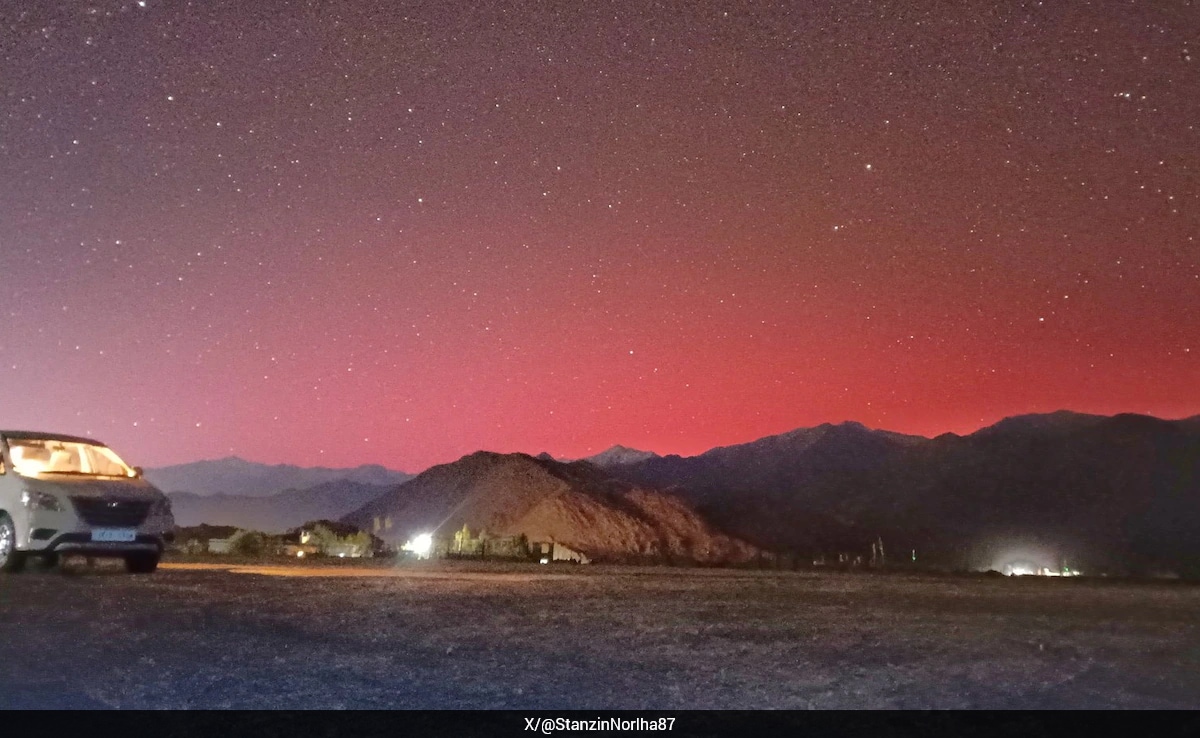
A powerful geomagnetic storm triggered by a fast coronal mass ejection from the Sun produced rare red aurora over Hanle, Ladakh, on January 1920, captured by the Indian Astronomical Observatory.
In a breathtaking celestial spectacle, the high-altitude skies above the Indian Astronomical Observatory (IAO) in Hanle, Ladakh, were set ablaze with an extraordinary blood-red aurora on the nights of January 19 and 20. This rare and vibrant display, a direct consequence of powerful space weather activity, captivated observers and scientists alike, offering a vivid reminder of the dynamic interplay between our Sun and Earth.
The all-sky camera at the observatory, operated by the esteemed Indian Institute of Astrophysics (IIA), meticulously captured the intense glow as highly charged solar particles collided with Earth's magnetic field at extreme altitudes. This interaction painted the night sky in hues rarely witnessed at such latitudes, typically reserved for regions closer to the Earth's poles.
According to scientists involved in the observation, this marked the sixth instance during the current solar cycle that such a profound and intense red aurora has graced the skies over Hanle. This remote region of Ladakh is globally renowned for its exceptionally dark skies and pristine atmospheric conditions, making it an ideal location for astronomical observation and space weather monitoring.
The genesis of this unusual spectacle can be traced back to a potent geomagnetic storm that commenced in the early hours of January 20. This storm was triggered by the arrival of a coronal mass ejection (CME) – a massive burst of solar wind plasma and magnetic fields – which had been launched from the Sun just two days prior, on January 18.
Observations from January 19 to January 21 clearly depicted these ethereal aurorae illuminating the night sky over Ladakh, a truly unforgettable sight. This rare occurrence served as a striking commencement to the year 2026, underscoring the profound impact of solar activity on our planet's magnetosphere.
Further analysis revealed that the CME responsible for this event was intrinsically linked to an X1.9-class solar flare. This powerful flare erupted from Active Region 14341, located near the center of the solar disk. The ejection was propelled at an incredibly high velocity, subsequently interacting with Earth's magnetosphere and escalating geomagnetic activity to a G4 severity level on the NOAA scale. This classification denotes a "severe" geomagnetic storm, possessing the capability to generate auroras far beyond the customary polar regions.
The distinctive deep red colour of the aurora, which made this event so remarkable, is a result of the excitation of oxygen atoms situated high in Earth's upper atmosphere. This intricate process was significantly amplified by the sheer energy of the particles carried within the coronal mass ejection. As these energetic particles bombard the oxygen atoms, they cause them to emit light at specific wavelengths, producing the characteristic crimson glow.
While such spectacular displays are a regular feature in the Arctic and Antarctic regions, their appearance at the latitude of Ladakh is exceedingly uncommon. This particular event serves as a potent reminder of the dynamic and often unpredictable nature of the Sun-Earth connection. It also highlights the escalating importance of continuous and rigorous monitoring of space weather impacts, not just for scientific understanding but also for potential implications on satellite communications, power grids, and aviation.
Both seasoned observers and dedicated scientists were utterly mesmerized by the magnificent spectacle. Authorities have reinforced the critical value of ongoing monitoring and advanced research conducted at state-of-the-art facilities like the IAO in Hanle. Such sustained efforts are paramount for deepening our comprehension of intense solar activity and for developing robust strategies to prepare for its potential effects on our technological infrastructure and daily lives.