NASA's New High-Resolution Map Shows Dark Matter In "Stunning Detail"
By NewsDose Team
Updated on January 28, 2026
5 min read
Key takeaways
The map provides insights into the universe's evolution, tracing dark matter's influence back to when galaxies were forming most actively.
A groundbreaking revelation from the cosmos has just offered humanity its most intricate glimpse yet into the elusive fabric that holds the universe together: dark matter. Leveraging the unparalleled capabilities of the James Webb Space Telescope (JWST) alongside decades of previous astronomical data, an international collaboration of scientists has produced the most detailed map ever created of this mysterious substance.
Published in the esteemed journal Nature Astronomy on January 26, this monumental study not only strengthens the prevailing cosmological model but also illuminates the profound influence dark matter wields over the formation and evolution of galaxies and galaxy clusters across the vast expanse of the universe. Researchers from esteemed institutions including Durham University, NASA's Jet Propulsion Laboratory (JPL), and the Ecole Polytechnique Federale de Lausanne (EPFL) in Switzerland, united their expertise to achieve this scientific milestone.
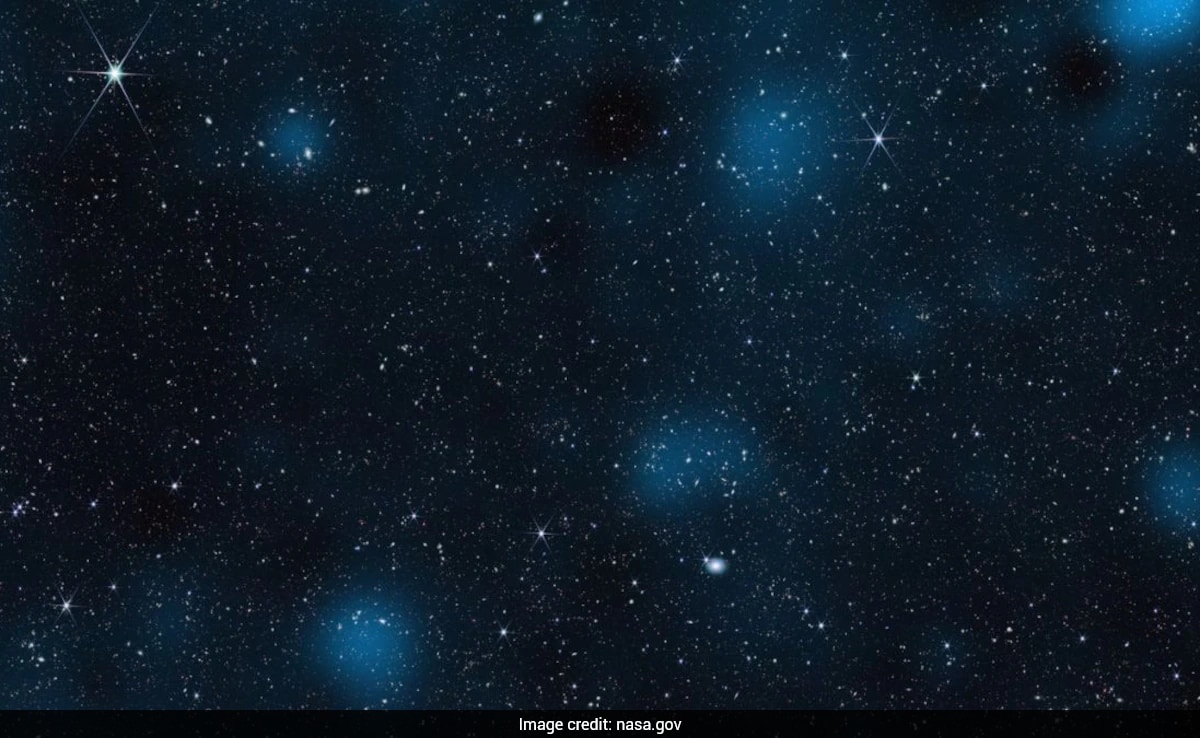
For centuries, scientists have theorized the existence of dark matter – an invisible entity that does not emit, absorb, or reflect light, yet its gravitational pull is undeniably responsible for the cohesive structure of galaxies. Until now, our understanding was largely based on indirect evidence. The new map, however, provides a striking visual representation, superimposing a detailed contour of dark matter, depicted in ethereal blue, over images of nearly 800,000 distant galaxies.
The JWST, with its extraordinary infrared vision, played a critical role in this achievement. Its ability to peer through cosmic dust and gas, observing light from the universe's earliest epochs, allowed scientists to detect the subtle distortions in the light from background galaxies – a phenomenon known as gravitational lensing. These minute bends in spacetime are tell-tale signs of massive, unseen gravitational influences, primarily attributed to dark matter concentrations.
"This is the largest dark matter map we've made with Webb, and it's twice as sharp as any dark matter map made by other observatories," remarked Diana Scognamiglio, lead author of the paper and an astrophysicist at NASA's JPL in Southern California. She added, "Previously, we were looking at a blurry picture of dark matter. Now we're seeing the invisible scaffolding of the universe in stunning detail, thanks to Webb's incredible resolution." This enhanced clarity means researchers can now investigate the intricate distribution of dark matter with unprecedented precision, uncovering nuances previously obscured.
What this high-resolution map vividly illustrates is the universe's cosmic web – a vast, interconnected network of dark matter filaments and nodes. The map reveals dense knots of dark matter coalescing around colossal galaxy clusters, while thinner, more delicate strands stretch between them, acting as cosmic highways. It is widely theorized that the immense gravitational pull of this dark matter web served as the initial framework, drawing in gas and dust, and thereby creating the perfect conditions for the birth and proliferation of galaxies throughout cosmic history.
Further reinforcing this symbiotic relationship, Richard Massey, an astrophysicist at Durham University in the United Kingdom, highlighted the striking congruence between visible matter and dark matter distribution. "Wherever we see a big cluster of thousands of galaxies, we also see an equally massive amount of dark matter in the same place. And when we see a thin string of regular matter connecting two of those clusters, we see a string of dark matter as well," Massey explained. "It's not just that they have the same shapes. This map shows us that dark matter and regular matter have always been in the same place. They grew up together." This co-evolutionary narrative underscores dark matter’s fundamental role, not just as a passive component, but as an active architect of the universe we observe.
While dark matter continues to present an enigmatic challenge to direct detection, its pervasive influence on the cosmos is now more undeniable than ever. This latest mapping effort provides invaluable insights into the universe's evolutionary timeline, enabling scientists to trace the impact of dark matter back to an era when galaxies were most actively forming. The implications of this research are profound, extending even to the very conditions necessary for life.
As one of the contributing researchers, Rhodes, emphasized, "This map provides stronger evidence that without dark matter, we might not have the elements in our galaxy that allowed life to appear." It’s a compelling thought: a substance invisible to us, undetectable by our current direct means, yet intrinsically linked to our very existence. Though dark matter remains an entity we don't encounter in our daily lives on Earth or even within our solar system, its silent gravitational hand has undeniably shaped the cosmic landscape that allowed humanity and life as we know it to emerge.
The journey to unravel the full mystery of dark matter is far from over, but this revolutionary map from the James Webb Space Telescope represents a colossal leap forward, opening new avenues for cosmological research and deepening our appreciation for the unseen forces that govern our universe.