Asteroid Could Hit The Moon In 2032, With Effects Felt On Earth: Study
By NewsDose Team
Updated on January 30, 2026
5 min read
Key takeaways
Scientists warn that a possible asteroid strike on the Moon in 2032 could send debris towards Earth and endanger satellites.
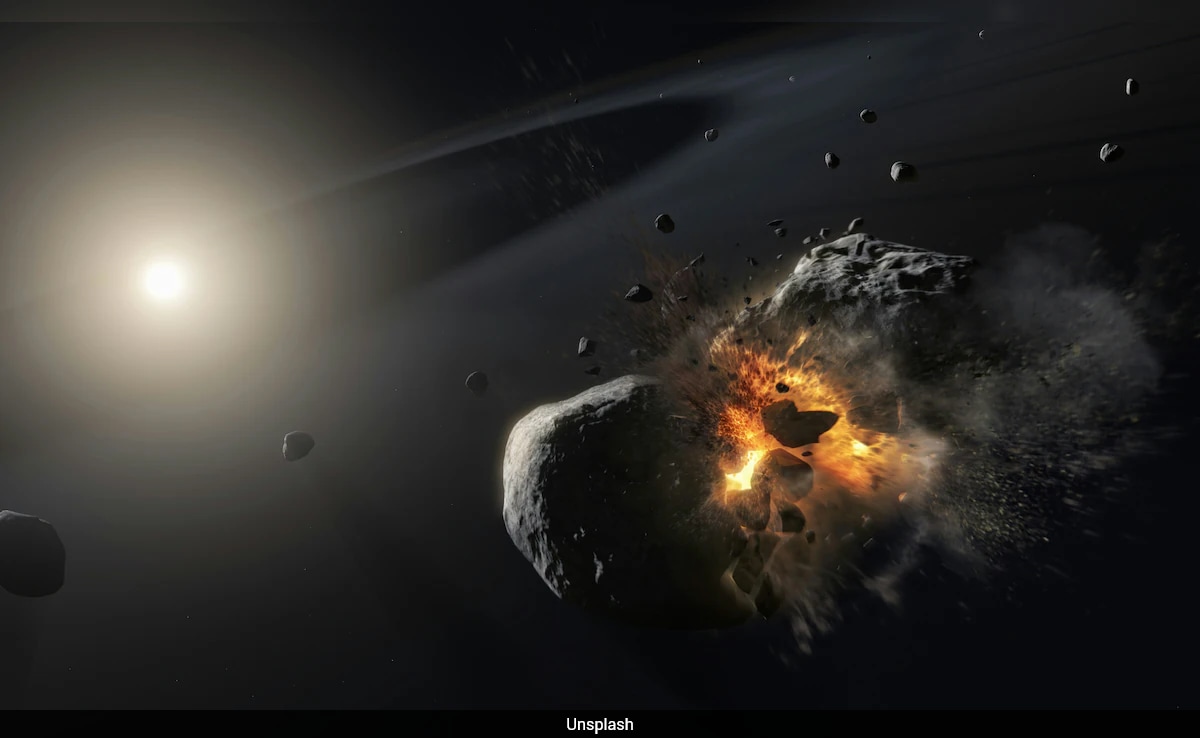
Scientists globally are intensely focused on a newly identified celestial body, Asteroid 2024 YR4, which presents a fascinating blend of potential peril and unprecedented scientific opportunity. This cosmic visitor is currently on a trajectory that gives it a slim, yet significant, 4 percent chance of colliding with Earth's Moon on December 22, 2032. While still eight years away, the potential ramifications for both lunar science and Earth's orbital environment are already prompting serious discussions among leading space agencies and researchers worldwide.
Estimated to be approximately 60 metres in diameter, Asteroid 2024 YR4 might seem modest in size, but its projected impact with the Moon would be far from negligible. A recent paper by Yifan He of Tsinghua University and his colleagues, published as a preprint on arXiv, delves into the profound scientific insights that such a rare event could yield. The extensive study suggests that if the asteroid were to strike, the energy unleashed would be comparable to a medium-sized thermonuclear explosion, making it potentially the most powerful lunar impact observed in modern astronomical history. This scale of impact promises to offer unparalleled data on celestial mechanics and surface dynamics.
Such an event would be a geophysical goldmine for planetary scientists. Researchers anticipate that a direct hit would excavate a colossal crater, roughly one kilometre wide, on the lunar surface. More crucially, it is expected to trigger a global moonquake, registering an estimated magnitude 5 on the seismic scale. This comprehensive seismic data would offer an invaluable, perhaps unparalleled, window into the Moon's deep interior – a region that has proven notoriously difficult for scientists to study directly due to its remoteness and the challenges of deploying sensitive instrumentation. Understanding the Moon's internal composition, thermal state, and geological structure is vital for piecing together the formation and early evolution of Earth and other rocky planetary bodies in our solar system.
Beyond the Moon itself, the potential impact carries significant implications for Earth. The colossal blast would propel vast quantities of lunar debris and pulverized rock into space. Simulations indicate that a fraction of this ejected material could embark on a complex journey towards Earth, potentially reaching our atmosphere just days after the initial lunar collision. This inbound debris could create a spectacular, intense meteor shower, far grander than typical annual displays, visible to the naked eye across specific regions, particularly parts of South America, North Africa, and the Arabian Peninsula. At its peak, projections suggest millions of meteors per hour could streak across the night sky, offering an astronomical spectacle unlike any seen in modern human history.
However, this cosmic spectacle comes with considerable risks that cannot be overlooked. While the vast majority of debris would likely burn up harmlessly upon atmospheric re-entry, larger fragments falling to Earth could pose a localized threat to property and infrastructure. More critically, space agencies worldwide are issuing warnings that a significant portion of the ejected material could enter Earth's complex orbital pathways, potentially threatening operational satellites. This scenario raises serious concerns about the dreaded Kessler Syndrome, a theoretical chain reaction where collisions generate more debris, leading to an exponential increase in orbital junk. Such an event could severely disrupt global communications, essential navigation systems like GPS, vital weather forecasting capabilities, and a myriad of other satellite-dependent services that underpin modern society and global economies.
Given the dual nature of this celestial threat and profound opportunity, a crucial debate is currently unfolding within the international scientific community and among global space organizations. Discussions are actively underway regarding the feasibility and necessity of launching a mission to deflect Asteroid 2024 YR4 from its potential collision course with the Moon. Scientists emphasize that any decision will involve a delicate and complex balance: prioritizing planetary safety and the protection of invaluable orbital infrastructure against the extremely rare, profound chance to observe an extraordinary natural experiment that could fundamentally advance our understanding of the cosmos and the processes that shape our solar system.
The monitoring of Asteroid 2024 YR4 will undoubtedly intensify significantly in the coming years. Advanced telescopic observations and sophisticated trajectory refinement will be absolutely critical in reducing the current uncertainties surrounding its exact path and potential impact probability. This ongoing vigilance underscores humanity's evolving capability to track and potentially mitigate cosmic threats, while also highlighting our enduring curiosity about the universe and the profound knowledge that even a distant celestial event could unlock, forever altering our perspective on our place within the cosmos.