India vs New Zealand LIVE Score Updates, U19 World Cup 2026: 7-Down NZ Staring At Sub-100 Total As India Strike Again
By NewsDose Team
Updated on January 24, 2026
5 min read
Key takeaways
India vs New Zealand U19 World Cup 2026, LIVE Score Updates: New Zealand are at risk of folding for less than 100 in a rain-affected high-stakes clash against India in Bulawayo.
In a gripping U19 Cricket World Cup 2026 fixture, marred by intermittent rain and a series of strategic adaptations, India U19 unleashed a formidable bowling display to put New Zealand U19 firmly on the back foot at the Queens Sports Club in Bulawayo. The young Blackcaps found themselves precariously placed at 72/7 after 25 overs, struggling desperately to stem the flow of wickets and runs against an inspired Indian attack in a contest ultimately curtailed to 37 overs per side.
The day's proceedings were dictated by the weather right from the outset. Initial reports of a damp outfield and persistent drizzle led to a significant delay in the toss, building anticipation and tension. However, when play eventually commenced, India captain Ayush Mhatre won the toss and made the decisive call to bowl first. This decision proved immediately impactful, as the conditions, though challenging due to the lingering moisture, offered considerable assistance to India’s pace battery, which wasted no time in making dramatic inroads.
India’s fast-bowling spearhead, RS Ambrish, was the undisputed architect of New Zealand’s early collapse. Delivering a spell of aggressive, accurate, and unplayable bowling, Ambrish tore through the top order with three pivotal wickets. His devastating opening salvo began with the dismissal of Hugo Bogue, who, attempting an expansive cut, only managed a thin edge through to the vigilant wicketkeeper Abhigyan Kundu. Ambrish then accounted for New Zealand’s captain, Tom Jones, who mistimed a pull shot that was expertly caught by a diving Ayush Mhatre at mid-off. Completing his triple-wicket haul, Ambrish delivered a searing inswinging yorker that left Marco Alpe's stumps shattered, utterly bamboozling the batter and leaving New Zealand reeling at an alarming rate.
The relentless pressure was amplified by pace partner Henil Patel, who complemented Ambrish’s aggression with tight lines, probing lengths, and subtle movement off the seam. Patel claimed his own significant scalp, luring Aryan Mann into an ill-judged shot outside off-stump. Mann's resulting nick flew safely into the gloves of Abhigyan Kundu, further exposing New Zealand’s fragile top order. This clinical dismantling reduced New Zealand U19 to a perilous 17/3 in just 7.1 overs, effectively stifling any chance of building early momentum and placing them in a deep hole.
However, India's dominant start was repeatedly punctuated by interruptions from the fickle elements. The first downpour, which inconveniently coincided with Henil Patel’s wicket, forced an immediate halt to play, with ground staff scrambling to cover the pitch. This initial delay led to the match being revised from a full 50-over contest to 47 overs per side. Despite the dedicated efforts of the ground staff, who worked tirelessly on a prominent wet patch on the outfield, applying copious amounts of sawdust, the rain returned with renewed intensity. This second, more prolonged stoppage necessitated a further reduction, ultimately settling the contest at a truncated 37 overs per side, forcing both teams to recalibrate their strategies significantly in pursuit of crucial Super 6 points.
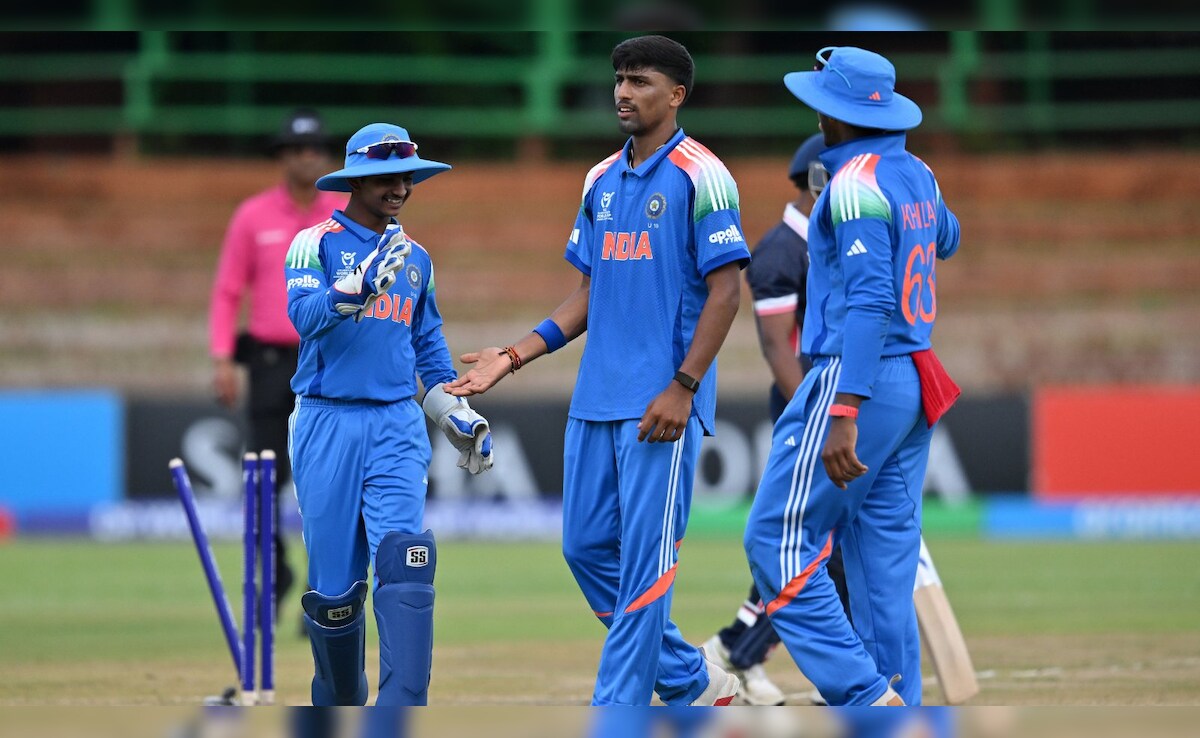
When play eventually resumed, New Zealand faced a monumental task of rebuilding their innings against a bowling unit that had gained both psychological and statistical advantage. The middle overs witnessed India's spinners seamlessly taking over from the pacers, maintaining an iron grip on proceedings. Khilan Patel, making an immediate impact in his very first over, secured a pivotal breakthrough. India-born batter Snehith Reddy stepped out of his crease, missed the flight of the delivery, and wicketkeeper Abhigyan Kundu capitalized with a brilliantly swift stumping. This crucial dismissal contributed to a wicket-maiden over for Khilan, underscoring India's complete and unwavering control over the scoreboard.
Amidst the unfolding collapse, Jacob Cotter offered a solitary beacon of resistance for New Zealand. Demonstrating commendable resolve and a willingness to fight, Cotter managed to find occasional boundaries, including a well-executed reverse sweep against Khilan Patel, which painstakingly brought up New Zealand's 50-run mark after an arduous 18.3 overs. Cotter, alongside Jaskaran Sandhu, attempted to forge the longest partnership of the innings, but scoring against the disciplined spin duo of Khilan Patel and Mohamed Enaan proved to be an exceptionally difficult endeavour, with runs coming in frustratingly slow trickles.
The fleeting partnership was eventually broken when Jaskaran Sandhu, attempting to break free with a powerful slog, was caught by Khilan Patel off the bowling of all-rounder Kanishk Chouhan. This wicket further deepened New Zealand's woes, reducing them to 59/6. Chouhan, a player who garnered considerable attention in the recent IPL 2026 auction, showcased his utility with the ball, adding another valuable dimension to India's versatile and potent attack, proving his worth on the global stage.
The final blow to New Zealand's innings, at least in this phase of play, came when Jacob Cotter, in an attempt to accelerate the scoring rate, tried another reverse sweep but only managed to feather an edge. Wicketkeeper Abhigyan Kundu, ever alert, completed a sharp catch, handing spinner Mohamed Enaan a significant wicket. This left New Zealand U19 seven wickets down and teetering on the brink of being bowled out for a score well below triple digits, a stark testament to India's clinical execution and unyielding pressure.
Beyond the immediate result, this match carries immense strategic importance for both teams, particularly concerning their path to the tournament's latter stages. Both India U19 and New Zealand U19 have already secured their berths in the Super 6 stage. Crucially, the points and, perhaps even more vital, the net-run-rate (NRR) accumulated from this encounter will be carried forward. India’s dominant display not only ensures a high-points tally but also significantly bolsters their NRR, providing a robust foundation for their campaign in the more competitive Super 6 phase and their ultimate push towards the semi-finals. This strategic advantage, especially in a group where margins can be tight, is invaluable.
India’s performance has been nothing short of exceptional, demonstrating a perfect blend of aggressive pace, disciplined spin, and astute captaincy by Ayush Mhatre. Their ability to adapt seamlessly to the challenging weather conditions and maintain relentless intensity throughout the shortened contest speaks volumes about their preparedness and resilience. This comprehensive victory against a strong New Zealand side, despite the numerous interruptions, unequivocally underscores India's formidable credentials as serious contenders for the U19 Cricket World Cup 2026 title, building on their dramatic prior victory against Bangladesh where Vihaan Malhotra’s four wickets sealed a narrow win. The young Indian Lions are roaring with confidence as they march deeper into the tournament.
You Might Also Like


More in Cricket
- "IPL 2026: BCCI Bans Rival Teams From Sharing Practice Pitches"
- BCCI Issues Strict Guidelines For All 10 Franchises Ahead Of IPL 2026
- "Laxman's 2001 Eden Epic: Why Mind Conquered Body for India"
- Why there’s always drama when it’s India vs Pakistan
- "Usman Tariq: T20 World Cup Action Baffles Batters, Sparks Debate"
