Sunil Gavaskar Slams Sanju Samson Over Dismissal In 4th New Zealand T20I, Gives 'Footwork' Verdict
By NewsDose Team
Updated on January 30, 2026
5 min read
Key takeaways
Indian cricket team wicket-keeper batter Sanju Samson failed to impress once again as he was dismissed for 24 during the fourth T20I encounter against New Zealand.
The performance of Indian wicketkeeper-batter Sanju Samson continues to be a focal point of discussion among cricket enthusiasts and pundits alike. His recent dismissal for a modest 24 runs during the fourth T20 International encounter against New Zealand has intensified the scrutiny on his position within the national squad, particularly with major tournaments on the horizon.
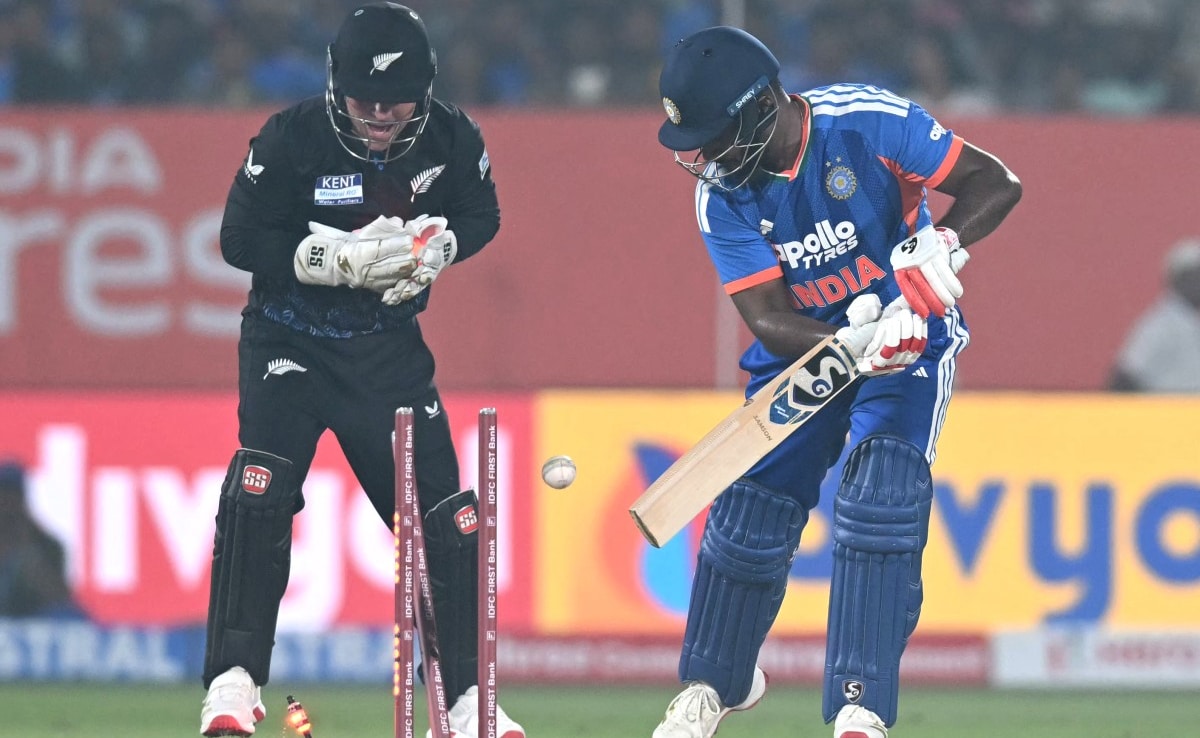
Samson, who had shown glimpses of his explosive potential earlier in his innings, was removed by New Zealand's spinner Mitchell Santner after facing 15 deliveries. This particular outing further exacerbated concerns surrounding his consistency, especially considering his cumulative score of just 40 runs across his last four matches. This dip in form comes at a critical juncture, as competition for spots in the T20 World Cup squad is fiercely contested, with Ishan Kishan, another promising wicketkeeper-batter, demonstrating strong performances at the crucial No. 3 batting position.
Legendary Indian captain and astute cricket commentator Sunil Gavaskar did not hold back in his assessment of Samson’s dismissal. Speaking emphatically during commentary, Gavaskar pointed directly to a significant deficiency in Samson's footwork as the primary cause for his downfall against Santner.
“My initial reaction was the complete absence of any footwork,” Gavaskar stated, dissecting the delivery with surgical precision. “I am not entirely convinced there was substantial turn on that ball; my first impression was that he simply stood rooted, attempting to create room and play the shot through the off-side without engaging his feet effectively.”
He further elaborated on his critique, highlighting a recurring technical flaw. “There was barely any movement from his feet. He was venturing outside the leg-stump, thereby exposing all three stumps to the bowler. In such situations, when a batter misses the line, the bowler is inevitably going to find the target. This unfortunate scenario has now played out for Sanju Samson for the second occasion,” Gavaskar added, underscoring a pattern of vulnerability.
The match itself proved to be a disheartening affair for the Indian contingent, as New Zealand secured a comprehensive 50-run victory in the fourth T20 International. Opting to bat first, the Black Caps launched an aggressive assault from the outset. Their innings was anchored by a blistering opening partnership between Tim Seifert, who blazed 62 runs off just 36 balls, and Devon Conway, who contributed a rapid 44 runs from 23 deliveries. This formidable duo amassed a century stand in a mere 8.2 overs, laying a rock-solid foundation for a mammoth total.
Despite the initial onslaught, India’s bowlers managed to stage a commendable comeback in the latter half of New Zealand’s innings. Arshdeep Singh and Kuldeep Yadav were particularly effective, each claiming two vital wickets to rein in the scoring rate. However, a late surge from Daryl Mitchell, who smashed an impactful 39 runs off only 18 balls, ensured that New Zealand posted an imposing total of 215 for seven.
In response to the challenging target, India's chase ultimately faltered despite some breathtaking individual performances. Shivam Dube delivered an extraordinary display of power-hitting, devastating the New Zealand bowlers with a brutal 65 runs from just 23 balls. Rinku Singh also played a crucial role, contributing a valiant 39 runs off 30 deliveries. However, their valiant efforts proved insufficient to overhaul the formidable target set by the hosts.
New Zealand captain Mitchell Santner emerged as the architect of India’s batting collapse, delivering a superb spell of 3/26 from his four overs. His tactical brilliance and accuracy played a pivotal role in dismantling the Indian batting lineup, leading to their eventual all-out score of 165 in 18.4 overs. The defeat not only highlights immediate performance concerns but also prompts a deeper look into team strategies and individual player roles as India continues its preparations for upcoming international assignments.
You Might Also Like


More in Cricket
- "IPL 2026: BCCI Bans Rival Teams From Sharing Practice Pitches"
- BCCI Issues Strict Guidelines For All 10 Franchises Ahead Of IPL 2026
- "Laxman's 2001 Eden Epic: Why Mind Conquered Body for India"
- Why there’s always drama when it’s India vs Pakistan
- "Usman Tariq: T20 World Cup Action Baffles Batters, Sparks Debate"
