"No Readback Of Landing Clearance": Final Moments On Ajit Pawar's Plane
By NewsDose Team
Updated on January 30, 2026
5 min read
Key takeaways
The airport in Maharashtra's Baramati near which the Learjet 45 private jet carrying Deputy Chief Minister Ajit Pawar crashed, killing all five on board is an 'uncontrolled' airfield with flight traffic information, the government said Wednesday.
A nation mourns following the tragic crash of a Learjet 45 near Baramati airport, Maharashtra, claiming the lives of all five individuals on board, including the state's Deputy Chief Minister, Ajit Pawar. The devastating incident has cast a somber shadow, prompting an immediate and extensive investigation into the circumstances that led to the fatal descent of the private jet.
The site of the accident, Baramati airfield, has been officially classified as an 'uncontrolled' facility. This critical detail signifies that the airfield operates without the constant vigilance and direction of conventional Air Traffic Control (ATC) services. Instead, flight traffic information and coordination are typically managed by pilots themselves, often with assistance from local flying school personnel. This operational model, while common for smaller airfields, introduces a unique set of challenges and protocols compared to busy international airports manned by dedicated ATC towers, making clear communication and adherence to procedures even more paramount.
The ill-fated journey began at 8:10 am, with the Learjet 45, registered as VT-SSK and owned by VSR Ventures Pvt Ltd, departing from Mumbai. Just eight minutes later, at 8:18 am, the aircraft established its initial contact with Baramati airport. The flight, spanning approximately 256 kilometers, was expected to conclude in less than 45 minutes, a seemingly routine hop across the state.
As the aircraft approached, approximately 30 nautical miles (55.6 km) from Baramati, control was seamlessly handed over from Pune air traffic services to the local ground personnel. Captain Shambhavi Pathak, the pilot, was promptly informed of the prevailing weather conditions and advised to proceed with landing at her discretion. Standard procedure dictates pilots inquire about wind speed and visibility, and Captain Pathak did so, receiving information that visibility stood at approximately 3000 metres (three kilometers) – a range generally considered sufficient for a safe landing attempt by aviation experts.
The aircraft subsequently reported its final approach to Runway 11. However, moments later, the pilot indicated that the landing strip was "not in sight." In such critical situations, standard operating procedure (SOP) dictates an immediate "go-around" – an aborted landing where the aircraft climbs and circles to attempt another approach. This maneuver is a fundamental safety protocol designed to prevent accidents when landing conditions are not optimal or clear.
Following the go-around, the plane was again queried about its position, to which the pilot confirmed a second final approach. Confirmation that the runway was now visible was sought and provided. At 8:34 am, the aircraft received clearance for landing. However, a significant and concerning deviation from protocol occurred: there was no "readback" of the landing clearance from the pilot. A readback, which involves the pilot repeating the instructions received from ground control, is a universal aviation safety measure ensuring mutual understanding and preventing miscommunication, especially crucial in uncontrolled environments where direct ATC oversight is absent.
The gravest turn of events unfolded at 8:43 am when the Learjet 45 "went silent." This meant the aircraft ceased transmitting ADS-B (Automatic Dependent Surveillance-Broadcast) signals. ADS-B is a vital technology that continuously broadcasts an aircraft's real-time position, altitude, speed, and identification to ground stations and other equipped aircraft, forming a critical layer of air traffic awareness. The cessation of these signals, approximately 20 kilometers from Baramati airport, indicated the aircraft was likely at an altitude of just over a kilometer and traveling at 237 kilometers per hour, moments before its tragic end.
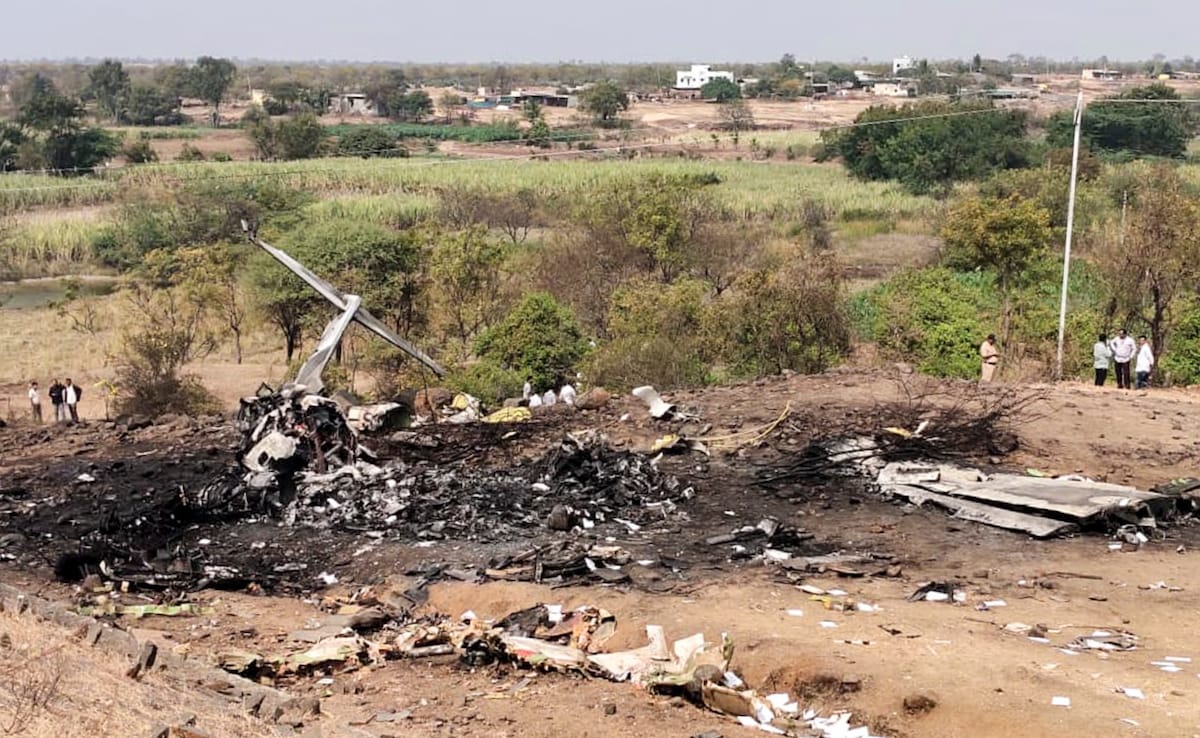
The catastrophic impact was tragically captured at 8:46:02 am, when CCTV footage from a nearby highway recorded a massive fireball and an escalating plume of smoke just minutes from the airport. Emergency services, alerted to the disaster, rapidly converged on the crash site. The wreckage, a scene of utter devastation, was discovered on the left side of the runway. Visuals from the ground depicted the mangled remains engulfed in flames and smoke, as first responders and horrified local residents scrambled to assist in any way possible, bearing witness to the profound tragedy.
In the grim aftermath, the body of Deputy Chief Minister Ajit Pawar was identified through his wristwatch, a poignant detail underscoring the severity of the crash. The Aircraft Accident Investigation Bureau (AAIB) has swiftly assumed control of the comprehensive probe, meticulously examining every facet of the incident to ascertain the precise cause and prevent future occurrences. The initial findings and ongoing analysis will be crucial in understanding the chain of events that led to this catastrophic loss.
Ajit Pawar, a towering figure in Maharashtra politics, leaves behind a significant legacy spanning over three decades. His career was marked by strategic political maneuvers, including the notable July 2023 event where he led a faction of the Nationalist Congress Party (NCP) to align with the BJP, forming the current state government. He is survived by his wife, Sunetra Pawar, a Rajya Sabha MP, and his two sons, Parth and Jay. His passing marks a profound loss not only for his family but also for the political landscape of Maharashtra and India, leaving a void in state leadership.
As the investigation progresses, the focus remains on uncovering the full truth behind this tragic aviation disaster, with authorities committed to a transparent and thorough inquiry into all contributing factors, including the operational procedures at uncontrolled airfields and adherence to critical safety protocols. The findings are anticipated to inform future aviation safety measures across the nation.
You Might Also Like


More in India
- "CBSE 10th Result 2026: Mid-April Release Expected Earlier"
- "महावीर जयंती 2026: 10 शिकवणी, शांती-यशाचा मार्ग उघडतील"
- "RBSE Class 12 Results 2026: Check Scores Fast, Avoid Website Crash"
- "Noida Airport: How It Solves Fog Delays & Long Check-In Lines"
- "CBSE 10th, 12th Results 2026: Expect April for Class 10?"
